Friday, October 26, 2007

WOMEN IN WAR

"Tell them we weren't the only ones."

My mother said that to me once just before I did a lecture about her experiences and my dad’s experiences as slave laborers in Nazi Germany. She wanted me to be sure I told the audience that my parents weren’t the only people that terrible things happened to in those concentration camps. I promised my mother I would, and in fact, when I got to the lecture hall that night and stood up in front of that audience the first thing I did was tell them what my mother told me to.
.
“We weren’t the only ones.”


For a long time, I thought I knew what she meant by that sentence. My mom hadn’t told me much about her experiences. My dad, however, had told me a lot about his terrible experiences during his five years in the Germany concentration camp system, and he also told me something about what had happened to my mother and her family, her mother, her sister, and her sister’s baby. They had been brutally murdered by the Nazis who came to their farm in eastern Poland. As I said, my mother didn’t talk about this experience or many of her other experiences for much of my life with her. I talk about this in one of my poems, “Here’s What My Mother Won’t Talk About.” In it, my mother’s response to my questions about her time under the Nazis is to tell me that I’m a fool and “If they give you bread, eat it. If they beat you, run.” That was pretty much it.

This last September, Tracy Meyers, the Director of the Women and Gender Studies Program at Valdosta State University, invited me to do a lecture and poetry reading about my mother’s experiences during and after the war.

To prepare for it, I started thinking about my mother’s experiences and her silence about so much that had happened to her. I re-read an article I read years before by Jessica Alpert called "Muted Testimony: Rape and Gendered Violence of the Holocaust." Alpert’s argument was that women tended not to talk about their experiences in the concentration camps and the death camps because of the sexual brutality they experienced. This led me to do some more research, and what I found out was that a lot of the histories and memoirs and literary writings about war talk about what men are doing in a war, but these histories don’t always look at what’s happening to women and how they are experiencing war.

It’s not surprising. Women’s experiences of war tend to be different than men’s experiences of war. Women’s experience tend to be brutal and without much glory or sense of victory or accomplishment. Doing a Google search of “women” and “war” brings up things like the Japanese rape of the city of Nanking. The actual number of rapes that occurred there is hard to pin down but they range from 20,000 to 80,000. One source said that when the Japanese soldiers weren’t raping the women, “They took great pleasure in forcing fathers to rape their daughters and sons to rape their mothers.” British historian Antony Beevor says in Berlin: The Downfall 1945 that the Russians raped millions of women as they moved west, pushing back the Germans in the final months of World War II. These women were not only German women but also Russian women and Polish women and Ukrainian women and the women in the liberated concentration and death camps.
.
In her study Victims, Heroes, Survivors: Sexual Violence on the Eastern Front in World War II (available on the internet), historian Wendy Jo Gertjejanssen argues that sexual violence against women by Russians and Germans both was common and seldom talked about.

Dr. Gertjejanssen says at the start of her study that sexual violence during the war happened to many, many women, perhaps millions, on the eastern front. These women were sexually abused and harassed, they were forced into military brothels, and they were raped and mutilated. Also, because they were deliberately starved, these women often found that they had to exchange sex for food and water to stay alive.


If you look at the memoirs left by women who had been in the camps, not many of these memoirs talk about the sexual brutality that took place in the camps. One of them that does is Seed of Sarah by Judith Isaacson. In fact, she talks about women’s silence about being sexually brutalized. In her book, Isaacson relates a conversation she had with her daughter about what happened to the women her mother knew during the war. Isaacson tells her that most of them had been raped and killed either by Nazis or the Russians. When her daughter wonders why no one ever hears about all of the women who were raped during the war, Isaacson answers, "The Anne Franks who survived rape don’t write their stories.”

Was my mother raped? Was she sexually brutalized?

These are hard questions for me to think about. They make me feel very sad. You want to think about the good things that happened to the ones you love; you don’t want to think of all the terrible things that might have happened. If my mother herself was not the victim of sexual brutalization, she must have seen it, and it must have hurt her deeply. One of the things my father frequently talked about and that I heard about from the time I was a kid was the story about the German soldier cutting a woman’s breasts with his bayonet. This woman was my aunt Genja who died with her baby and my grandmother when the Germans came to my mother’s farm.

Toward the end of her life, my mother told me about how she cried and couldn’t stop crying after this killing. I wrote a poem about it called “Grief.” It talks about how she was taken to Germany after the death of her sister Genja and the baby and her mother. Here it is:

Grief

My mother cried for a week, first in the boxcars
then in the camps. Her friends said, “Tekla,
don’t cry, the Germans will shoot you
and leave you in the field,” but she couldn’t stop.

Even when she had no more tears, she cried,
cried the way a dog will gulp for air
when it’s choking on a stick or some bone
it’s dug up in a garden and swallowed.

The woman in charge gave her a cold look
and knocked her down with her fist like a man,
and then told her if she didn’t stop crying
she would call the guard to stop her crying.

But my mother couldn’t stop. The howling
was something loose in her nothing could stop.

----------------------------------------------

I want to say one more things. The poet Christina Pacosz sent me an email a couple weeks ago reminding me that bad things haven’t stopped happening with the end of World War II. She’s absolutely right.

This comes from a UNICEF post on Sexual Violence as a Weapon of War:

"The State of the World's Children 1996 report notes that the disintegration of families in times of war leaves women and girls especially vulnerable to violence. Nearly 80 per cent of the 53 million people uprooted by wars today are women and children. When fathers, husbands, brothers and sons are drawn away to fight, they leave women, the very young and the elderly to fend for themselves. In Bosnia and Herzegovina, Myanmar and Somalia, refugee families frequently cite rape or the fear of rape as a key factor in their decisions to seek refuge."(http://www.unicef.org/sowc96pk/sexviol.htm)

My mother wasn’t the only one.
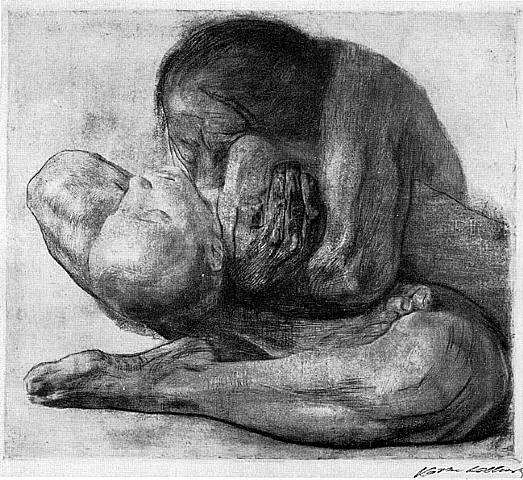

(Drawing by Kathe Kollwitz)

Wednesday, October 10, 2007

HISTORY AND NUMBERS

I was invited by Gladys Kirkland to give a series of poetry readings/lectures about my parents and their experiences in World War II to the Freshmen Social Studies students at Valdosta High School last Thursday (Oct.4), and I wrote up an introduction that I hoped would get the students interested in what I was telling them about.

I know that a lot of the students I had over the years at Eastern Illinois University hated to hear about wars and such because it sounded to them like war was just a bunch of numbers. I was afraid that the students at VHS would respond like that, so I wrote up this introduction. I wanted them to know that the war was more than just numbers. I ended up not using the introduction because the students at VHS didn't seem afraid of numbers, but I hate to write something and not use it so I thought I would post my introduction here.

HISTORY AND NUMBERS

History is full of numbers, dates, fractions, the number of this, the number of that.

Maybe you’ve heard of the M-1 rifle or the V-2 bomb or the B-17 bomber, or 2nd Lieutenants and Privates first class and 5-star generals.

We even give numbers to Wars. There was the 100 Year War, the War of 1812, the First World War, and World War II. Right now the US is fighting what’s some times called the Second Gulf War.


But it's the Second World War that I'm here to talk about.

If you go on line, and Google WWII statistics, you’ll get a lot of numbers, enough to fill up a couple or more textbooks.

You’ll find out that the Nazis murdered 6,000,000 Jews. You’ll find out that altogether 52,000,000 people died in the war, more or less. You’ll hear that 20 million died in Russia, 7,000,000 died in Germany. 2 million in Japan. I was surprised to hear that Yugoslavia, a country that I don’t think much about anymore and probably never did, lost 1.7 million people. The country my parents came from was Poland, and it lost 1/6 of its population. Before the war, there were 36 million Poles; that means about 6 million died. In Warsaw, the capitol city of Poland, a quarter of a million civilians died during a 60 day battle to throw the Germans out in 1944.


America got off pretty easy in WWII. It lost just a half a million, mostly soldiers. In those other countries it was about half soldiers and half civilians. “Civilians” is another way of saying wives and husbands and their children.

There are also the numbers involved in how much was spent on the war. The numbers here run pretty high. The U.S. spent the most money on the war, an estimated $341 billion. Germany was next, with $272 billion, followed by the Soviet Union with $192 billion. All the billions spent probably add up to a trillion.
There are also numbers associated with what kind of mess was made by the war. The Soviet government calculated that Russia lost 30 percent of its national wealth. As far as I can figure, that means it lost one out of every three of everything: houses, banks, cars, schools, railroads, bikes, and farms.

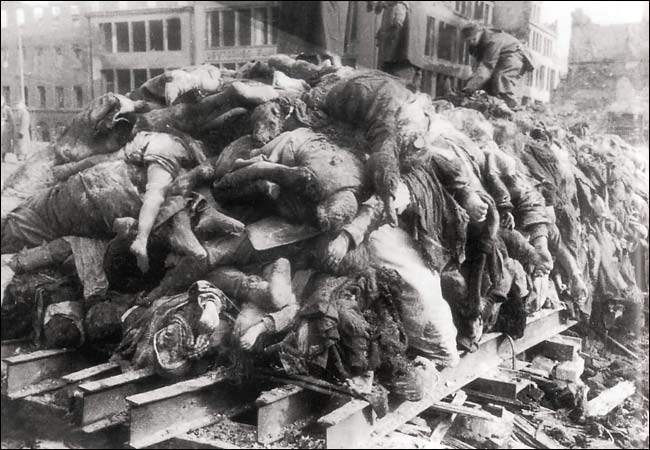
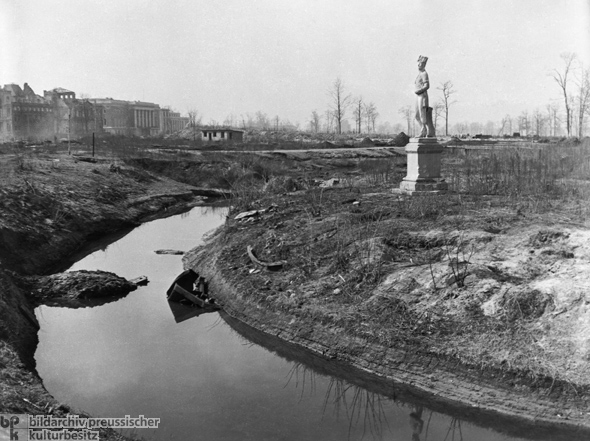
In Germany, bombing and shelling produced 4 billion cu m (5 billion cu yd) of rubble. I don’t know how big a pile that is but it sounds like a big pile of rubble. By the end of the war, the Germany capitol Berlin had been pretty much leveled. The people that count up such things estimate that 400,000 buildings were destroyed in Berlin. After the war, the Germans who survived the war got shovels and bulldozers and shoved all of those 400,000 building out of the city. Altogether there was about 17,000,000 cubic yards of rubble, bricks, bits of glass and silverware that melted together during the bombings, wood beams, busted up furniture, rusting pipes and porcelain bathtubs. It made a mountain 390 foot tall that in the past was used by Berliners looking to ski in the winter. It’s called Teufelsberg in German. That means Devil’s Mountain.

War does generate a lot of numbers, and the numbers tend to be big.

I was talking to a friend at VSU, a mathematician, a person who studies numbers, and she said that most people can’t imagine a number larger than 1000.

I know I can’t.

I only think about small numbers, human numbers. My mother, for example, would be one, my dad would be another one. That’s two, the two my poems are about.


(The photos are from the book The Fire: The Bombing of Germany, 1939-1945 by the historian Jörg Friedrich--there's a link to it on the right hand side.)

Friday, September 14, 2007

DPs in the Polish Triangle, Chicago, 1950s

When we came to America in 1951, we soon settled in Chicago where there was and still is a huge Polish community. My parents, however, mainly associated with other DPs. They felt that the Poles who had come before, what people called the "old immigration," didn't much care for the DPs. We were the poor, the huddled masses, the wretched refuse of Europe's shore--like in Emma Lazarus's poem on the Statue of Liberty--and the Poles who were here already didn't much want anything to do with DPs who reminded them of what poverty and dirt and need were like. Or at least this was the way we saw it.


My parents called the older immigrants Warsavjaki (forgive my spelling). The older immigrants tended to treat the DPs like farmers/yokels/hillbillies, and the DPs tended to look on the older immigrants as effete, pretentious, hi-falutin’ urbanites. There wasn't a lot of social commerce going on between the two groups.

When we first came to Chicago, we settled in what's been called the Polish Triangle, an area bordered by California, Milwaukee, and Division. I don't know how many Poles there were there, but it felt like everyone was a Pole. A lot of the store owners, priests, cops, trash men, teachers, librarians, either spoke Polish or had family that spoke Polish. You would walk past stores that had signs that said, “Mowimy Po Polsku” (We speak Polish). There were taverns and restaurants too with names that reminded the DPs of home: Sawa, The White Eagle, Old Warsaw.

But not everything was like a scene from some old movie about the American Melting Pot and how it worked to make us all a happy family of Americans. There were people who looked at DPs like they were vermin. We got some of this from the older Polish immigrants, and we got this from some some non-Poles too. I remember walking around with my father looking for rooms on Milwaukee Avenue that we could rent, and having people turn us away when they heard we were DPs. DPs were dirty, unreliable. They were drunkards, wife beaters, criminals, and bar fighters.

I'm not sure why this was. I would have thought that people would have been sympathetic to the DPs, aware of the kinds of trials and struggles they had experienced in the slave labor and concentration camps, but maybe I'm being naive. People probably just saw DPs as another problem, guys and gals after their jobs on the assembly lines at the Motorola and Zenith plants, or down at the docks in Calumet City or Navy Pier.

At first when we came to America, we lived in single rooms. We would rent a room in an apartment on Belden Avenue or Hamilton Street, and there would be other DP families renting other rooms in this apartment. I remember our first Christmas in the US. We were living in one of these rooms and a guy dressed as Santa was going from room to room passing out simple toys to the DP kids in those rooms. I got a tin army tank and a ball with a star on it. My sister got a jack in the box. America didn’t seem so bad.

All the time, my parents were working. My father worked the day shift, and my mother worked the night shift. This way there would usually be somebody home with my sister and me. My parents did this for years. Sometimes my dad would work two shifts, the 8am to 4pm, and the 4 pm to midnight shift; and he would do this 6 days a week. He wouldn't come home except on Saturday night, and then he would stay until Monday morning. When he was away working his double shifts, he slept in a room in the factory. I remember visiting him once. He had a cot to sleep on and a little box to store his stuff.

He and my mother worked in all kinds of factories, string factories, TV factories, perfume factories. My mother even worked for a time in a factory making walkie-talkies for the GIs fighting against the Communists in Korea. She worked the punch presses in the molding room. She’d come home with burn scars on her arms from the black plastic that melted and settled on them. Fifty years later when she was in a hospice dying from a stroke, I held her hand, and I could still read the scars there.

All of this crazy work my parents were doing started bringing in enough money so that we were moving out of the single rooms into double rooms and then whole apartments and then into an apartment in a building my parents bought at 2633 Potomac in Chicago. It must have been 1954, three years after we got to America, that they bought that first building.

Reading over this, I feel like I'm almost writing about the great American success story. The immigrants who come here with nothing but sand in their pockets; and in a couple of years, they're buying apartment buildings and driving around in black Cadillacs, smoking fat Cubans and dreaming about dating Marilyn Monroe--but it wasn't like that.

The war had come down like a hammer on my parents, and they were still reeling from the blow. My father drank whenever he could. He never drank when he was working but when he wasn’t working he would be down at the White Eagle tavern on the corner or down at the Sto Lat tavern on the next block. He was a black-out drunk. The only thing that would stop him from drinking was getting so drunk that he would pass out. When I got older, I would be sent to look for him in the bars on Division Street. I would find him pretty much gone, still able to walk but barely. I would help him make the trip home. Sometimes, I couldn’t get him up the stairs to our second floor apartment, and I would set him down in the basement where he would sleep it off.

When he would drink, what he wanted to do was talk about the war to anybody. He would talk about the camps and the beatings he got and what happened to him and his friends. And he would talk about the great Polish generals of the Second World War, Sikorski and Anders, and how the Polish soldiers fighting along side the Allies took revenge on Hitler and the Germans for what they did to Poland and Warsaw, how they leveled both like they were wooden outhouses. He loved to sing the songs that came out of the war, especially the one about the red poppies that covered the battlefield of Monte Cassino where so many Polish soldiers died, fighting up that mountain in the middle of the boot of Italy. I can still hear his voice getting deeper and quieter as he sang about those poppies and how the blood of the Poles can still be seen in those red flowers.

He also used to carry around a picture of a gallows in Germany where 5-6 Poles were hanging. He would take this into the bars with him and show it to whomever he could, and he would start talking about what happened to these men and the others in the concentration and slave labor camps he had been in. The photograph finally got so ragged from being passed around in the bars on Division Street that there was nothing left of it but tatters. After my father died, I looked for that photo in the shoebox of old pictures my mom kept under the TV set. I couldn't find it. He must have been carrying the tatters around in his old age.

But losing that old gallows picture didn’t matter to him, because he could also talk about the scar on his head, and he could point to his dead eye, the one that never closed. He would tell strangers about how he was clubbed by a Nazi guard for refusing to eat soup that was so inedible that even a starving man – which he was – would have to think twice before spooning that stuff into his mouth.

Sometimes, I would get my drunk father home, and my mother would start in. Normally, she was very quiet, unemotional, almost frozen. But when she saw him like this, she would explode.


She hated his drinking, and she would slap him and kick him and curse him. I learned all the Polish swear words I needed to know from her: psia krev, pierron, schlag trafi, kurva matzh, and others. He would just lie on the floor and take it. Sometimes he would try to crawl away from him, and she’d follow him across the living room floor, kicking him or beating him with a broom. He never raised a hand to hit her. He would just say, “yes, I deserve it” or “I’m sorry, Tessa.” That’s what he would call her, that or Mamusha. That means mother in Polish.

She would explode like this sometimes when she felt that my sister Donna had done something wrong too. If she sassed her, or refused to eat something my mother prepared, or tried to get out of watching me, my mother would slap her or chase her around the house with a broom. My sister would try to hide even under a bed, but my mother would get her, drag her out and beat her. As my sister got older, she would realize that there was no place in the house that she could hide so she ran outside, ran into the night, and after my mother quieted down, I would go out looking for my sister, trying to find her at a friend’s house or hiding somewhere in a neighbor’s basement.

My mother was the opposite of my father in a lot of ways. He would drink and she wouldn’t. She would get violent and abusive, and he never raised his hand to my sister or me or my mother. Another way was in how they treated the war, responded to it. While my father took every occasion to talk about the past, she never wanted to talk about what happened. If I asked her to tell me something about what had happened in the war, she would ignore me, just turn away. I felt that all of what was bad about our situation, being DPs and having a drunk father and a violent mother, came from the war somehow, but she wouldn’t tell me about it. If I pressed her, all she would say was, “If they give you bread, eat it; if they beat you, run.”

Even when we were living in America and safe at last, she never got much beyond that warning.

Saturday, September 1, 2007

Upcoming Poetry Reading

I'll be doing some poetry readings over the next couple weeks and I thought I would mention them here and invite everybody to the readings. In all of the readings, I'll be reading from my two new books about my parents and their experiences in the slave labor camps: Lightning and Ashes and Third Winter of War: Buchenwald.

The first reading is for the lecture series sponsored by the Women's and Gender Studies program at VSU. It will be at 7pm, Tuesday, Sept. 11 at the Bailey Science Center at Valdosta State University.

Here's some info about that and the entire series : http://www.valdosta.edu/womenstudies/UpcomingEvents_000.shtml

The following week I'll be giving a reading at Western Kentucky University, at 7pm, Tuesday, Sept. 18.

The next day, I'll be reading my poems about my parents as part of the Eastern Illinois University conference on World War II and James Jones. The reading is at 3pm, Sept. 19, in the library.

Here's the website with further information:

http://evff.net/conference-schedule-tentative/

All of the above are free and open to the public, but if you can't come, you can hear and see me read on line.

Janusz Zalewski and Henryk Gajewski put together a website of readings from the January 2007 PAHA conference.

Here's that link: http://gajewski.tv/poets/

Thursday, August 9, 2007

A Wooden Trunk

When I posted my blog about the wooden trunk my parents carried from Germany, I received a number of comments and emails about wooden trunks and samovars and cooking utensils and other things the Poles who came to this country from the DP camps in Germany brought with them after the war.

[If you want to read the original post, here's the url:
http://lightning-and-ashes.blogspot.com/2007_06_01_archive.html]

One of those emails came from Christiana Conway. Here's what she said.

"I read briefly your blog and wish to tell you I was born in one of those DP camps...Wildflecken, 1946. I also have a trunk just as you described your parents had. It was painted a dark brown outside, and inside it is plain wood with I believe my mom's name stamped on it. I would never have parted with it. I recently acquired it (somehow my brother wound up with it and I discovered this when they were moving. He planed on dumping it at the curb) It is the only piece of memorabilia I own that was of my Mother's and my journey to the USA."

Christiana also sent me a series of pictures of the trunk her parents brought from Wildflecken, the DP camp for Poles that Kathryn Hulme talks about in The Wild Place.
.
Here are two of the pictures:
.
This is a picture of the trunk from the side. Chris took the photo in her basement.


The next is a picture of the surface of the trunk. If you look closely, you can see some of the lettering beneath the layer of brown paint. Before being painted over, the lettering may have indicated where Christina's parents were coming from or where they were going. Christina is thinking of doing a rubbing of the trunk to see if she can retrieve some of those words that were painted over.
.
She says she can make out her mom's name on the lid of the trunk, Marie Chodacka, and under her name, Christiana says she can read, but only barely, the name of Frank Kozak of Clinton, NY, USA. Christiana feels that Frank must have been her family's sponsor to the USA . He was her sister's godfather, and he owned a dairy farm in Clinton. When Christiana was a child, she spent some summers there.

Thanks, Chris.

Thursday, July 19, 2007

THIRD WINTER OF WAR: BUCHENWALD

My chapbook about my father’s experiences in Buchenwald has just been published by Finishing Line Press, and I wanted to say something about how I came to write the book and why the book is the way it is, focusing solely on my father Jan Guzlowski.

When I wrote Language of Mules, my first book about my parents, I felt that it was mainly about my mother. Poems like “Cattle Train to Magdeburg,” “Here’s What My Mother Won’t Talk About,” and “My Mother Talks about the Slave Labor Camps” carried a lot of the weight of the book. For me emotionally, they were the points in the book that I always came back to. The last poem I wrote for that book was the long, four-part poem “My Mother Talks about the Slave Labor Camps,” and that poem seemed to make all of the other poems about my mother coalesce around it. They were the poems that I always read when I did poetry readings. In fact, a lot of times at those readings, I would mostly read the poems about my mother in Language of Mules. They had a psychological and emotional unity and power that spoke to me every time. And they seemed to speak to my audiences too. People would invariably ask questions about my mom, but seldom did they ask about my father.


In Lightning and Ashes, my second book about my parents, I wanted to talk about both my parents. They had been together for forty-two years when my dad died in 1997, and I wanted to write about what that life was like, the war that brought them together and the memories of shared suffering that had kept them together despite their differences and their antagonism. The book feels balanced to me. In fact, I sometimes think that my parents are almost having a conversation in that book. My mother talks about her experiences, and then my dad talks about his, and I’m once again a child listening to their talk and trying to make sense of the lives they lived.

I feel that Third Winter of War: Buchenwald is my father’s book. He was a man who could never be quiet about the war, a man who could never put it aside. My mother could, and frequently she’d tell my father he should too, but he couldn’t. The war was always as present as it had been in 1943. He was a man who could talk for hours about the war, with me, if I was around, with strangers if I wasn’t, with himself if no one was around. Sometimes, I would come into a room where he was sitting and he would be having silent conversations. He would be gesturing, grimacing, turning his head this way and that. His lips would be moving, but he wouldn’t be talking. I would ask him what he was going on, and he would relax and smile, and say something like, “I’ve been thinking about the Germans.”

He was a man who prayed every day for the people he knew who died in the war, and he was a man who dreamt nightmares about the war. When I was a child living at home, I would hear his screams. They would wake us all. I don’t think I’ve ever heard screams like that. They were muffled in an odd way. Screams, in my experience, are usually accompanied by an explosion of air. My father’s nightmare screams were drawn in. Even in his sleep, it was almost like he was afraid to scream. I would come to my father’s bedroom, and he would be asleep and screaming and struggling with the Germans who were beating him.

I wanted to write about these nightmares, and by writing about them, I wanted to understand and capture what the war must have been like for him. I wanted to capture the thing that caused his nightmares and the nightmares themselves. I wanted to write about his hungry days searching through the bricks of the bombed cities he was forced to work in, and the threats and beatings he received. I wanted to know what he felt in the third winter of the war when he was in Buchenwald and felt he would never get out.

That’s what I wanted, but what I realized finally was that I could never understand his war or capture it. I would always just be a tourist walking through his experiences with a sketchpad and a pencil.


Third Winter of War is available from Finishing Line Press
http://www.finishinglinepress.com/2006newreleasesandforthcomingtitles.htm

Wednesday, July 18, 2007

An Interview

I was interviewed last January by Bruce Guernsey of Spoon River Poetry Review, and that journal has recently given me permission to reprint the interview.

If you want to take a look at the interview and a photo of me eating some kind of strange soup, you'll find both at my Everything's Jake blog.

It's at: http://everythings-jake.blogspot.com/