Thursday, March 20, 2014

Night in the Labor Camp


My father spent 4 years as a slave laborer in Nazi Germany.  He was a prisoner in Buchenwald and its sub camps.  He worked in its factories and its field.  He plowed, shovelled, and scrambled through bricks looking for dead Germans.  He did the work the Germans told him to do.

When the war ended, he was 25 years old, weighed 75 pounds, and had only one eye.  He had seen men die singly and in large numbers.  He had seen them hanged, shot, castrated, beaten to death with clubs, and left to stand in the snow till they fell to their knees and died.

I often think about what he must have thought about it all, the long years, the hunger and suffering.  Here's a poem that tries to get at that.

Night in the Labor Camp

Through the nearest window
my father stares at the sky and thinks
of his dead father and mother,
his dead sister and brother,

his dead aunt and dead uncle,
his dead friend Jashu, and the boy
whose name he didn’t know
who died in his arms, and all

the others who wait for him
like the first light of the sun
and the work he has to do
when the sun wakes him.

He hates no one, not God,
not the dead who come to him,
not the Germans who caught him,
not even himself for being alive.

He is a man held together
with stitches he has laced himself.

—appeared in Echoes of Tattered Tongues, reprinted in the journal War, Literature, and the Arts

What the War Taught Her


Today, at George Washington High School here in Danville, I did a poetry reading about my mom and her experiences as a slave laborer in Nazi Germany.  Here's one of the poems I read, from my book  Echoes of Tattered Tongues.

What the War Taught Her

My mother learned that sex is bad, 
Men are worthless, it is always cold 
And there is never enough to eat.

She learned that if you are stupid
With your hands you will not survive
The winter even if you survive the fall.

She learned that only the young survive
The camps.  The old are left in piles
Like worthless paper, and babies
Are scarce like chickens and bread.

She learned that the world is a broken place 
Where no birds sing, and even angels
Cannot bear the sorrows God gives them.

She learned that you don't pray 
Your enemies will not torment you.  
You only pray that they will not kill you.

___________________________

The photo above is a still taken from  Siege, a documentary by Julien Bryan about the fall of Warsaw.

Thursday, February 27, 2014

Radiant Poetry

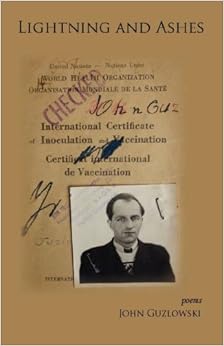
Here's a review of my book Lightning and Ashes by Grady Harp.  He's one of Amazon's Top Ten Reviewers.


Radiant Poetry

John Guzlowski has presented us with a book of poems based on his family's harrowing life in the Nazi concentration camps and their subsequent move to the United States, forever tattooed with the horrors of the war experience. The reader begins to look for the reasons for the author's parents confinement - they were Christians, not gypsies, not radicals - and we must turn to the explanation the writer gives for the truth: ' I was born in a refugee camp in Germany after World War II, and came with my parents Jan and Tekla and my sister Donna to the United States as Displaced Persons in 1951. My parents had been slave laborers in Nazi Germany. Growing up in the immigrant and DP neighborhoods around Humboldt Park in Chicago, I met Jewish hardware store clerks with Auschwitz tattoos on their wrists, Polish cavalry officers who still mourned for their dead horses, and women who walked from Siberia to Iran to escape the Russians. My poems try to remember them and their voices.' 

What flows from the pages of this book are exchanges of words and creation of memories shared by the author's mother and father about these experiences. Guzlowski's poems are clear, uncluttered by needless metaphors or superimposed styles of writing. They simply speak to us of the horrors experienced and the aftermath of lives forever changed. 

What the War Taught Her 

My mother learned that sex is bad, 
Men are worthless, it is always cold 
And there is never enough to eat. 

She learned that if you are stupid 
With your hands you will not survive 
The winter even if you survive the fall. 

She learned that only the young survive 
The camps. The old are left in piles 
Like worthless paper. and babies 
Are scarce like chickens and bread. 

She learned that the world is a broken place 
Where no birds sing, and even angels 
Cannot bear the sorrows God gives them. 

She learned that you don't pray 
Your enemies will not torment you. 
You only pray that they will not kill you. 

or from the conversations with his father he writes: 

What My Father Ate 

He ate what he couldn't eat, 
what his mother taught him not to: 
brown grass, small ships of wood, the dirt 
beneath his gray dark fingernails. 

He ate the leaves off tress. He ate bark. 
He ate the flies that tormented 
the mules working in the fields. 
He ate what would kill a man 

in the normal course of his life; 
leather buttons, cloth caps, anything 
small enough to get into his mouth. 
He ate roots. He ate newspaper. 

In his slow clumsy hunger 
he idid what the birds did, picked 
for oats or corn or any kind of seed 
in the dry dung left by the cows. 

And when there was nothing to eat 
he'd search the ground for pebbles 
and they would looses his saliva 
and he would swallow that. 
And the other men did the same. 

Poetry so seemingly simple expresses more anguish, more ache, more compassion than a hundred thick historical novels about the war. The final long poem 'The Third Winter of War: Buchenwald' is unbearably painful to read, but read and remember it we must so that this can never happen again.

Grady Harp

___________________

Mr. Harp is one of Amazon's Top 10 Reviewers.  Here's an article about him from Slate.

Friday, February 14, 2014

Valentine's Day: A World War Two Love Story

My parents met in a concentration camp in Germany toward the end of World War II.


My mom had been brought to Germany by the Nazis to work in a slave labor camp. The day she was captured she saw her mom and her sister and her sister's baby killed by German soldiers. My mom was crying so much when she got to the camp that one of the guards said if she didn't stop crying they would shoot her.

Near the end of the war, my dad and some other slave laborers were brought to my mom's camp by German guards who were escaping the Russians. The Germans left him there and fled toward the American lines. When my mom saw my dad, he was a scarecrow in rags. He weighed about 70 pounds and had only one eye. He had lost the other when a guard clubbed him for begging for food.

She was 23, he was 25. She had been a slave for 2 years, he had been one for 4.

They met in that camp, and after liberation they did what a lot of people did. First, they had something to eat, and then they got married.

It was a hell of a marriage. They fought and argued for the next 50 years -- even on Sunday mornings -- and even on Christmas Day.

It got so bad at times that -- after we came to America -- my sister and I would plead with my parents to get a divorce.

They never did. When my dad died in 1997, they were still married. 52 years.

When I was about 57 or 58, I started wondering why they didn't get a divorce, why they stayed together through all the misery they put each other through. The answer to that question became a poem in my book about them, Lightning and Ashes. The poem is called "Why My Mother Stayed with My Father."


Why My Mother Stayed with My Father

She knew he was worthless the first time
she saw him in the camps: his blind eye,
his small size, the way his clothes carried
the smell of the dead men who wore them before.

In America she learned he couldn’t fix a leak
or drive a nail straight. He knew nothing
about the world, the way the planets moved,
the tides. The moon was just a hole in the sky,

electricity a mystery as great as death.
The first time lightning shorted the fuses,
he fell to his knees and prayed to Blessed Mary
to bring back the miracle of light and lamps.

He was a drunk too. Some Fridays he drank
his check away as soon as he left work.
When she’d see him stagger, she’d knock him down
and kick him till he wept. He wouldn’t crawl away.

He was too embarrassed. Sober, he’d beg
in the bars on Division for food or rent
till even the drunks and bartenders
took pity on this dumb polack.

My father was like that, but he stayed
with her through her madness in the camps
when she searched among the dead for her sister,
and he stayed when it came back in America.

Maybe this was why my mother stayed.
She knew only a man worthless as mud,
worthless as a broken dog would suffer
with her through all of her sorrow.

________

If you want to read more about my parents, you can read an article I wrote about how they met in a concentration camp at the end of the war.  Here's the link: How My Parents Met.

You can also heck out a couple of the blogs here that talk mostly about them. One is called DPs in the Polish Triangle about what my mom and dad were like when they got to America. Another is called The Wooden Trunk We Carried With Us From Germany. There's also The Day My Mother Died.

Just click on the above titles, and it will take you right to them.

My book about my parents is called Echoes of Tattered Tongues, and it's available from Amazon.

Monday, January 27, 2014

International Holocaust Remembrance Day, Jan. 28


My father spent four years as a slave laborer in Nazi Germany, and my mother spent two and a half years there.  They were two of about 12 million people who were taken to Germany to do the work the Germans needed done while their own workforce was out trying to conquer Europe.

My parents weren't Jewish, but they knew people who were.  Poland was a country with a large Jewish population, and Jews had lived in Poland for almost a millenium.

Like I said, my parents knew Jewish people.  Two of my mom's aunts in fact married two Jewish fellows, twins.  The four of them died in Auschwitz.

Here's a poem I wrote about what my mom thought about the war and the things that happened.

WHAT THE WAR TAUGHT HER

My mother learned that sex is bad,
Men are worthless, it is always cold
And there is never enough to eat.

She learned that if you are stupid
With your hands you will not survive
The winter even if you survive the fall.

She learned that only the young survive
The camps.  The old are left in piles
Like worthless paper, and babies
Are scarce like chickens and bread.

She learned that the world is a broken place
Where no birds sing, and even angels
Cannot bear the sorrows God gives them.

She learned that you don't pray
Your enemies will not torment you. 

You only pray that they will not kill you.


Friday, January 24, 2014

My Mother and the Wolves

 
My mother grew up in a forest in Eastern Poland in the 1920s and 30s. She could hear wolves howling in the winter, and she listened to her mother's stories and warnings and passed them on to me.
This is a poem about the stories my grandmother told my mom.

My Mother and the Wolves

In their log house in the forests
west of Lvov, my grandmother
told my mother tales in the winter
to pry her thoughts from the sound
of trees splitting with the cold,
exploding with a crack like that
of her father's double-barreled shotgun

A cat, she would say, can't be trusted.
It comes in the short spring night
and sleeps on the priest's chest
watching his adam's apple
as if it were some mouse hidden
under a blanket of stubbled skin
and then striking its sudden claws
through his skin into cartilage

And what of the wolves, she'd ask,
the nine wolves that in the winter's
grey stone dawn would smash
their bones against the door,
hammering like hungry seals
until the door splinters and the baby
is got at – even from the cradle
even from its precious sleep?

And listen, Tekla, my mother's mother
would whisper then, there are men
as bad as wolves that no door
– no matter how solid the oak –
will keep out.

So trust in Jesus
in the world of clouds far beyond
the frozen forests of this frozen world

Do this always, and fear the greedy hens.
_________________________
My grandmother was shot to death by German soldiers.  They also killed my aunt and her infant daughter.   My mom was taken to Germany where she was a slave laborer  for almost three years.
The poem recently appeared in Main Street Rag.  

I write about my mom and her experiences in my book Lightning and Ashes.   Here's an amazon link to the book.  Just click here.

Friday, December 6, 2013

My Father's Birthday

 father

My dad was born on Dec. 11, 1920 in Poland. By the time he was five years old, he was an orphan living on his uncle's small farm north of Poznan. In 1941, he was captured by the Nazis and taken to Germany. He spent four years in a concentration camp there. After the war, he spent another six years in refugee camps.

When he came to America finally, he had nothing with him but his family and the lessons he learned as a boy in Poland and Germany.

Here is a part of a poem about what it was like for him when he came to America. It's called "Looking for Work in America." It's from my book about him and my mom, Lightning and Ashes. 


LOOKING FOR WORK IN AMERICA

He knew death the way a blind man
knows his mother’s voice. He had walked
through villages in Poland and Germany

where only the old were left to search
for oats in the fields or beg the soldiers
for a cup of milk. He knew the dead,

the way they smelled and their dark full faces,
the clack of their teeth when they were desperate
to tell you of their lives. Once he watched

a woman in the moments before she died
take a stick and try to write her name
in the mud where she lay. He’d buried

children too, and he knew he could do any kind
of work a man could ask him to do.
He knew there was only work or death.

He could dig up beets and drag fallen trees
without bread or hope. The war taught him how.
He came to the States with this and his tools,

hands that had worked bricks and frozen mud
and knew the language the shit bosses spoke.

________________________
Here's a link to Garrison Keillor reading my poem "What My Father Believed."  Just click here