Tuesday, May 3, 2016

May 3 -- Polish Constitution Day


In the 50s, when I was a child growing up around Humboldt Park in Chicago, the biggest non-religious holiday was not Halloween or the 4 of July or Memorial Day. It was always May 3, Polish Constitution Day, Trzeciego Maja. My family would start preparing weeks ahead of time, cleaning the house, sprucing up what needed to be painted, sanded, or nailed, making sure we would have the food and drink we'd need for all of our guests.

We lived only about a half a block from the park where every year Poles celebrated the 3rd of May, and we knew that there would be dozens and dozens of our Polish friends stopping by to help us celebrate after the big parade in the park and all of the speeches by local and national politicians.

This holiday was important not just because it gave Polish friends a chance to celebrate the way they did in the Old Country, but because it re-affirmed a promise they had made to each other and to Poland. They had promised never to forget Poland, never to give up fighting for her freedom. 


Poland had also made a promise to them, and the 3rd of May was the day when she re-affirmed her promise. She promised that despite all the chains that she was shackled by, all the foreign armies that occupied her and raped her and spat on her, she would remain the country of their dreams and hopes forever. 

This was one of the things my dad taught me, the sacredness of the 3rd of May, and the sacredness of this promise.

Shortly after he died, I wrote a poem about the 3rd of May and what that date meant to him. It's called "Poland."


Poland 

They’ll never see it again, these old Poles
with their dreams of Poland. My father
told me when I was a boy that those who tried
in ‘45 were turned back at the borders 


by shoeless Russians dressed in rags and riding
shaggy ponies. The Poles fled through the woods,
the unlucky ones left behind, dead
or what’s worse wounded, the lucky ones


gone back to wait in the old barracks
in the concentration and labor camps
in Gatersleben or Wildflecken
for some miracle that would return them 


to Poznan or Katowice. But God
wasn’t listening or His hands were busy
somewhere else. Later, in America
these Poles gathered with their brothers


and with their precious sons and daughters
every May 3, Polish Constitution Day,
to pray for the flag. There was no question
then what the colors stood for, red for all 


that bleeding sorrow, white for innocence.
And always the old songs telling the world
Poland would never fall so long as poppies
flower red, and flesh can conquer rock or steel. 


-- from Echoes of Tattered Tongues: Memory Unfolded
.

PS: If you want to read some of the history behind May 3rd, Polish Constitution Day, you can check out a brief article in Polonia Today.

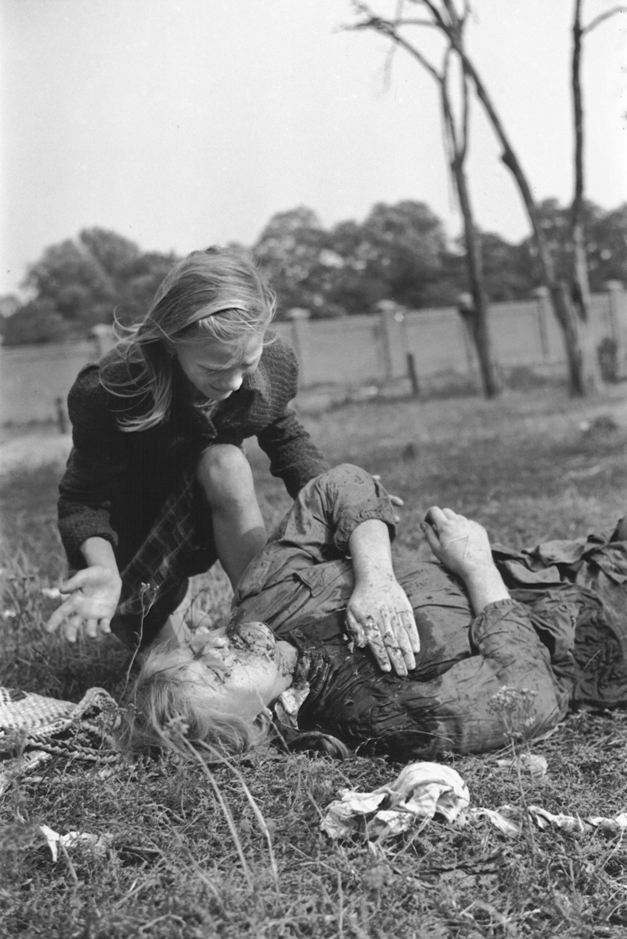
The photo is from John Vachon's photographic record of life in Poland following the war, Poland 1946.

Friday, April 29, 2016

Poem for a Rainy Day


THE DEATH OF THE POET JOHN MILTON, NOV 8, 1674 
(as described by the writer john guzlowski)

John Milton died alone in his room,
his daughter Ann picking herbs
in the garden, parsley and rosemary.
She said she’d be right back,

and he said nothing.  He was dying,
and didn’t want his daughter with him.
There was something about the way
she sat in silence next to the bed

that made him want to turn his head.
And he knew if he did, she’d ask him
if he were in pain, and her concern
troubled him.  He knew when he died

she’d mourn for him, and her mourning
would be brutal.  Her heart was tender,
and every misery touched her hard.
Dying, he didn’t want to think of it.

He wanted to be free of the mourning world,
free of everything, free of  all the sadness
that woke him early every morning,
and seemed to sleep at night but never did.

He wanted only to think of the poem
he burned because he knew finishing it
would have brought misery to Ann,
but he loved thinking about the poem,

and so he lay there, dying and thinking
about the poem he burned in the fireplace.

Its first line?  Wasn’t it, “In His bright day,
the world awaits” something, something,
something?

__________

This poem originally appeared in The Atticus Review.  If you click on that link, you'll be taken to a page where you can access several of my other poems, including "The Bakers of Auschwitz" and "A Brief History of Sorrow."

Friday, March 25, 2016

Easter Poem


My father wasn't an educated man.  He was born on a small farm in western Poland and never attended school.  He used to joke that the German concentration camp he spent 4 years in was his college and university.

He didn't know much about stuff most of us take for granted.  One of the things he didn't know much about was religion.  You couldn't talk to him about things like Moses or the Garden of Eden or the Holy Trinity, even though he was born a Catholic.

But he had a strong faith, and there were things that he believed with a certainty as sure as the turning of the earth.   This is a poem about that.

What My Father Believed 

He didn’t know about the Rock of Ages
or bringing in the sheaves or Jacob’s ladder
or gathering at the beautiful river 
that flows beneath the throne of God.
He’d never heard of the Baltimore Catechism
either, and didn’t know the purpose of life 
was to love and honor and serve God.

He‘d been to the village church as a boy 
in Poland, and knew he was Catholic
because his mother and father were buried 
in a cemetery under wooden crosses. 
His sister Catherine was buried there too. 

The day their mother died Catherine took 
to the kitchen corner where the stove sat,
and cried.  She wouldn’t eat or drink, just cried
until she died there, died of a broken heart.
She was three or four years old, he was five.

What he knew about the nature of God 
and religion came from the sermons
the priests told at mass, and this got mixed up
with his own life.  He knew living was hard, 
and that even children are meant to suffer.  
Sometimes, when he was drinking he’d ask,
“Didn’t God send his own son here to suffer?”

He believed life is hard, and we should
help each other.  If you see someone 
on a cross, his weight pulling him down 
and breaking his muscles, you should try 
to lift him, even if only for a minute,
even though you know lifting won’t save him.

_____________________________

The poem is taken from my book Echoes of Tattered Tongues, available from Amazon.

The illustration at the top of the page is by the artist Voytek Luka from my book Third Winter of War: Buchenwald.

Thursday, March 17, 2016

St. Patrick's Day Poem: Quarantine by Eavan Boland


In honor of St. Patrick's Day, here's one of the great contemporary Irish poems by the poet Eavan Boland, a poet who has inspired so much of my own writing.
Quarantine
In the worst hour of the worst season
    of the worst year of a whole people
a man set out from the workhouse with his wife.
He was walking – they were both walking – north.

She was sick with famine fever and could not keep up.
     He lifted her and put her on his back.
He walked like that west and west and north.
Until at nightfall under freezing stars they arrived.

In the morning they were both found dead.
    Of cold. Of hunger. Of the toxins of a whole history.
But her feet were held against his breastbone.
The last heat of his flesh was his last gift to her.

Let no love poem ever come to this threshold.
     There is no place here for the inexact
praise of the easy graces and sensuality of the body.
There is only time for this merciless inventory:

Their death together in the winter of 1847.
      Also what they suffered. How they lived.
And what there is between a man and woman.
And in which darkness it can best be proved.

Monday, March 14, 2016

ECHOES OF TATTERED TONGUES: MEMORY UNFOLDED


My new memoir in prose and poetry about my family and its experiences during and after World War II is now available.

Here are some early reviews and responses: 


“A searing memoir.” Shelf Awareness

"Devastating, one-of-a-kind collection.” Foreword Reviews


“Powerful...Deserves attention and high regard.” Kevin Stein, Poet Laureate of Illinois

“Deeply moving. A powerful, lasting, and sometimes shocking book. Superb.” Kelly Cherry, Poet Laureate of Virginia

“Unforgettable. An historical and literary revelation.” Cosmopolitan Review

“Exceptional…even astonished me…reveals an enormous ability for grasping reality.” Nobel Laureate Czesław Miłosz on Guzlowski’s earlier work.


The book is availble from Amazon and other bookstores.  


Tuesday, March 8, 2016

International Woman's Day


My mother was taken to Germany as a slave laborer in 1942 after seeing the women and girls in her family raped and killed by the Germans.

She worked in various small camps.  The work was brutal, and when she first arrived in Germany in November, the cold and snow was so bad that she didn't think she would survive a week.  She survived 3 years.

This is a poem about her.


WHAT THE WAR TAUGHT HER

My mother learned that sex is bad, 
Men are worthless, it is always cold 
And there is never enough to eat.

She learned that if you are stupid
With your hands you will not survive
The winter even if you survive the fall.

She learned that only the young survive
The camps. The old are left in piles
Like worthless paper, and babies
Are scarce like chickens and bread.

She learned that the world is a broken place 
Where no birds sing, and even angels
Cannot bear the sorrows God gives them.

She learned that you don't pray 
Your enemies will not torment you. 
You only pray that they will not kill you.

____________

The poem is from my book about her and my dad: Echoes of Tattered Tongues: Memory Unfolded

Monday, March 7, 2016

A Question about the War


What can we say about the past when so much of the past is lost? My mother felt the weight of her mother's death and her sister's death and her sister's baby's death at the hands of the Nazis all her life, but what can I know of those deaths. There was my mother's horror when she told me the stories, but my mother could not tell me much without breaking down, turning her face and its tears away from me. And so what's left to learn, what can I know about my mother's grief, my grandmother's face when she was shot again and again, my aunt's absolute sorrow when she saw her baby daughter kicked to death, the baby's screams that would not stop. There are no photographs of what happened, no news reports, no eye witnesses now that even my mother is gone, and all that's left is just a handful of broken memories that will never truly belong to me. What's left to say?

_______________________

The image above is taken from Siege, an Oscar nominated documentary about the German invasion of Poland. It is available from Aquila Polonica Press. Click here.