Tuesday, July 12, 2022

Me and Thoreau and My Dad


On Henry David Thoreau’s 205th birthday 

ME AND THOREAU AND MY DAD

Thoreau is an author I love. 

When my daughter was a kid, I would reel out these Thoreau quotes on every occasion whether we were making vegetable soup or going to a funeral.  I would have a quote, and I always acknowledged my quotes.  "Like Thoreau used to say ..."

I thought I was giving her gospel that would help her in all circumstances.  It would be the universal clock that Melville writes about somewhere--right in all longitudes and latitudes.

I was wrong--but have never learned how wrong.

I taught Thoreau’s book Walden for years and expected students to say, "Yeah, this makes sense." They never said that.

Students hated him. Hated it.

He goes so much against their grain, and against the grain of any practical person. 

I was reading a review in the New Yorker about some book from Oxford U Press about technology in the 19th century, and the reviewer points out that Thoreau was the anti-modern.  The whole world wants to go forward into the 20 century and then the 21 century--except Thoreau.  He wants to take us all back to the 18th century!

People don't want to be farmers--lead simple lives.

Let me tell you a story and then I'll stop.

My father grew up on a farm in Poland--my mother did too.  My dad then spent 5 years in Germany as a Slave Laborer, and 6 years as a refugee.  When he and my mom finally came to America, they were offered the opportunity to work on a farm in upstate New York, make a living and settle there.  They stayed on the farm there long enough to pay off their passage over from Germany.  

Then, they moved to Chicago (3 million people, coal dust in the air, not a cow in sight [they have some now at Lincoln Park Zoo]).  My parents worked in factories, double shifts, never took vacations.  There was nothing rural/bucolic about their lives there.  I once asked them, "Why didn't you stay on the farm in Upstate New York?  The trees the cows the quiet"

My mother said, "Are you kidding?"

Working a shift and a half everyday in a factory where melting plastic burnt their arms and chemicals scarred their lungs was better than working on a farm.

PS

I know I could never live on a farm.  Not now.  It's no country for old men.  I can barely keep track of the garden in my backyard, the leaves of grass in my front.  

But I know I can still read Thoreau, and dream about the forests beyond the garden in my backyard.  

____________

The photo is one I took of Walden Pond about 10 years ago on a Saturday afternoon in early September.

Tuesday, June 21, 2022

I Can’t Boogie Anymore!

 I Can’t Boogie Anymore!

On June 22, I will be 74 years old, and as you can imagine I’ve been thinking a lot about aging recently and about what I’ve learned over the years.

One of the things I’ve learned is that I can’t boogie any more no matter how hard I try, but you probably figured that out for yourself, so let me get down to what else I’ve learned.

One of those other things is that aging isn’t easy. My father used to say, “Aging isn’t for sissies.”

As I watched him age, I realized he was right. In his mid-70s, he barely had the strength to lift a gallon of milk because of his breathing problems. My mom’s aging was much worse. I watched her drag herself through two cancers, chemo, several strokes, major heart trouble, and more. I haven’t had the health problems they had so far, and I’m thankful for that.

Something else I learned from my parents about aging is never to give up hope. When my dad was dying of liver cancer, he tried to climb out of the hospital bed repeatedly and go home. My mom was the same. Even when she had the final stroke that left her almost completely paralyzed, she still made it clear to me that she wanted to live, that she didn’t want the doctors to give her the drugs that would just let her die peacefully without a struggle. My mom used to say that “Hope is our mother,” and I’ve learned over the years that she was right.

Another thing that I’ve learned is the importance of family. As I look at my life now, I realize that the best thing that happened to me is that I married a person who was the best person for me. My wife Linda and I have been married for 47 years. Our marriage and the family we’ve made has given me more happiness than my years as a professor and the books I’ve written and continue to write.

I’ve learned a lot of other stuff, but I just want to mention one other thing I’ve learned.

I’m 74 now, and what I’ve learned about life’s changes is that we change the way the great glaciers change. Slowly.

One year we melt a little. The next we freeze a little. A wind comes from some place then and shines up our northern walls. The following year the wind is a little stronger or weaker. We don’t change the way people in books change. Today’s hero, tomorrow’s fool.

Our future—a patient grandmother with a toddler in hand—comes slowly.

—


My latest column for the Dziennik Zwiazkowy 


https://dziennikzwiazkowy.com/felietony2/nie-moge-juz-tanczyc-i-cant-boogie-anymore/


-

Friday, June 10, 2022

DO WE LEARN ANYTHING FROM HISTORY?


Do we learn from history? 

As my mother – a woman who lived through a lot of history – would say, "That's the question."  

I’ve been thinking about this a lot recently because of what’s been happening in the news.  First, there is all that terrible news about the Russian war against Ukraine.  It seems to go on and on and makes me think of all the wars I’ve known during my 74 years.  Then, if that wasn’t bad enough, we’ve started hearing a flood of news about the war in the United States against the children and the good people here.  So far there have been 232 mass shootings in our country since the beginning of the year.  I seem to go to sleep every night hearing about one mass shooting, and I seem to wake up every morning hearing about a different mass shooting.  

I read about all this and hear about it repeatedly on the news, and I ask myself repeatedly “Don’t we learn anything from history?”

Apparently not.  The wars and the killings that are happening today will also be happening tomorrow and the day after and the day after that. The politicians who could change things are too busy appearing on the news shows to tell us why they can’t do a thing.

So what does history teach us?

Maybe what history teaches us is that the only good we can ever have is that SUV, that Lexus or Infiniti or Mercedes Benz we dream of.

Forget trying to stop the wars that are affecting so many.  Forget trying to prevent the deaths of school children. Forget trying to get justice for this or that person.  Forget trying to convince some murderous fool to appreciate the sanctity of other people’s lives. Forget trying to make the world a better place.

All there is -- all that we can really hope for -- is that shiny Lexus supercar or that chrome Samsung refrigerator or that brand new Apple iPhone with direct access to a world of games like Wordle and sudoku because grace, justice, brotherhood, love, the age of aquarius, harmony and understanding are all lies.

You don’t think so?

Here's something Saul Bellow, a guy from my old neighborhood in Chicago who won the Nobel Prize for Literature, said:

"You think history is the history of loving hearts?  You fool!  Look at these millions of dead.  Can you pity them? Feel for them?  You can do nothing!  There were too many. We burned them to ashes, we buried them with bulldozers.  History is the history of cruelty, not love."

 I’ve known big-time history professors and sociologists who wonder about stuff like: What can history teach us?  But most people aren’t asking this question. It seems like most of the 7 billion people on earth are  asking, "Where can I get a good price on a Toyota Highlander?"

And why do they want to get that Toyota Highlander?  

Because they know if they don't get it now before the next horde comes down from the mountains or the next ice age descends on us or the next war starts or the next killer shows up at the Walmart down the street, they'll never get that Toyota Highlander, never touch something that once for a couple of minutes gave them the illusion that things were looking up.

 —

My latest column for the Dziennik Zwiazkowy 

https://dziennikzwiazkowy.com/felietony2/czy-przeszlosc-czegos-nas-nauczylaczy-wyciagamy-wnioski-z-historii/


-

Friday, May 27, 2022

THIS IS NOT NORMAL

 THIS IS NOT NORMAL

My daughter Lillian is an elementary school principal.  She wrote something a couple days ago in response to the school shooting in Texas that left 19 children and 2 teachers dead. The piece was published today in the Polish Daily News in Chicago.

Here's what she wrote:

I’ve been in public education for 18 years. Ten years as a high school English teacher and eight years as an administrator. I am currently finishing my second year as an elementary school principal. I’ve been in lockdowns and lockdown drills.

I’ve had to plan what I would do in my classroom to protect myself and my students. My last year teaching, I had a couple of filing cabinets which probably seemed awkwardly placed to the casual visitor, but which I had put there deliberately to create a blind corner you couldn’t see from the door or the windows. I also figured the thick metal and folders stuffed with exams and essays could help slow bullets. I was hoping to save my students by offering their drafts of college application essays as collateral damage.

As an administrator, I’ve had to plan for the worst case scenario. I’ve locked my buildings down. I’ve searched for weapons and bombs. I’ve worked on reunification plans. I’ve planned which classrooms and hallways would be for relieved parents and which for those who will never see their children alive again. I’ve had to remind my colleagues that if the worst happens we can’t expect all our faculty/staff to be able to help. Some of them will have their own children to search for.

I’m also a mom. My daughter is in middle school. She has grown up with lockdown drills. When she used to play school with her dolls and stuffies, practicing lockdowns was part of the lesson. Now that she is older, she knows that her phone has to be fully charged when she goes to school—it has to be on do not disturb, but it can never be turned off in case I need to find her. In case something happens.

There are lots of things I should worry about when I send my daughter to school in the morning—who she’ll sit with at lunch, whether she’ll do a good job on a presentation, whether she’ll get the part she wants in the school play. I shouldn’t have to worry about whether someone will enter her classroom and shoot at her or her friends. The parents who send their children to my school shouldn’t have to worry about whether or not their children will come home. My teachers shouldn’t have to worry about whether today will be the day they have to die shielding their students from a shooter.

Something has to change. We have to change. We can’t keep acting like this is normal.

https://dziennikzwiazkowy.com/felietony2/to-nie-jest-normalne-this-is-not-normal/

.

Friday, May 20, 2022

WHAT THE SISTERS TAUGHT ME

WHAT THE SISTERS TAUGHT US


I received a letter recently from a fellow who frequently reads my columns in the Dziennik Zwiazkowy.  He was disappointed in some of my recent columns, especially the one defending Art Spiegelman’s Maus, a book about the Holocaust.  This reader thought my article was a waste of time and simply opened up a lot of unhealed wounds.  He suggested instead that I should write articles about Catholic schools in Chicago.  He feels they are losing students because they are under attack by atheism, LGBT culture, and the forces of Anti-Catholicism in America.

My first response to the letter was to just ignore it, but then I started thinking about how much going to a Catholic school changed my life.  

I started at St. Fidelis, a parochial school in Chicago, in 1954 when I was 6 years old.  I was a refugee and could barely speak English then.  The sisters at that school pretty much made me the person I am.  They prepared me to be the university professor I was for 35 years and the poet and novelist I am today.  Without my Catholic schooling by the nuns at St. Fidelis, I don’t know what I would have become.  

Thinking about all of this, I thought about the other students at St. Fidelis and how the sisters changed their lives.  I’m in a Facebook group devoted to St. Fidelis.  There are about 500 former students in the group, and I asked them what they learned from the sisters.  

Here’s what the other students who attended St. Fidelis told me.

Probably the most important lessons were in the area of basic skills: reading, writing, and mathematics.  Reading and writing were primary.  I felt that way myself.  I came from a working-class home where my parents had very little experience with either reading or writing, but by the time I was in second grade I had my own library card and was a frequent visitor at the Humboldt Branch of the Chicago Public Library.  The nuns were also committed to make us math champs.  Some of the former students talked about playing Baseball Math, a blackboard competition to see who could answer math questions the fastest.  I remembered Sister Xavier expecting us to define math terms as fast as we could.  She would shout out words like “minuend” and “subtrahend”  and expect us to shout back the definition without hesitation.  

These basic skills were supposed to prepare us for high school, and they did. Many of us found ourselves in college preparatory classes in high schools.

Today, looking back on all this, it seems remarkable. A number of students at the school were first generation Polish Americans or Displaced Persons who had come over from refugee camps after the war.  We were the children of moms and dads who spoke little or no English, and still we were transformed by the sisters at St. Fidelis into people who became college professors and doctors and medical researchers and scientists and army officers and journalists and writers.

Thanks to those sisters.

https://dziennikzwiazkowy.com/felietony2/czego-nauczyly-nas-zakonnice/

-

Friday, April 29, 2022

The War Goes On

THE WAR GOES ON 

Like you, I’m tired of hearing about Putin’s war against Ukraine.  It started two months ago on Monday, February 21, and everyone was sure that it would be over within a few days. Russia seemed unstoppable, a major world power with unlimited ability to destroy and kill, and Ukraine seemed ill-prepared and in a daze.  We all expected the war to be over by that weekend.

But the war didn’t stop, and there doesn’t seem any sign that it will stop any time soon.

Everyday, I open the paper and turn on the news and go on social media, and I hear about the Russian forces advancing here and pulling back there.  I hear about the Ukrainians doing the unbelievable, standing up to the Russians and pushing them back slowly to the borders of their country.  I hear about the Polish government issuing a 36-page guide telling Poles how they should prepare for a possible invasion of Poland and – what’s worse – a possible nuclear attack.

And I hear more than that.  I hear the news that I don’t want to hear.  I hear about the misery this war has caused for the Ukrainians. 

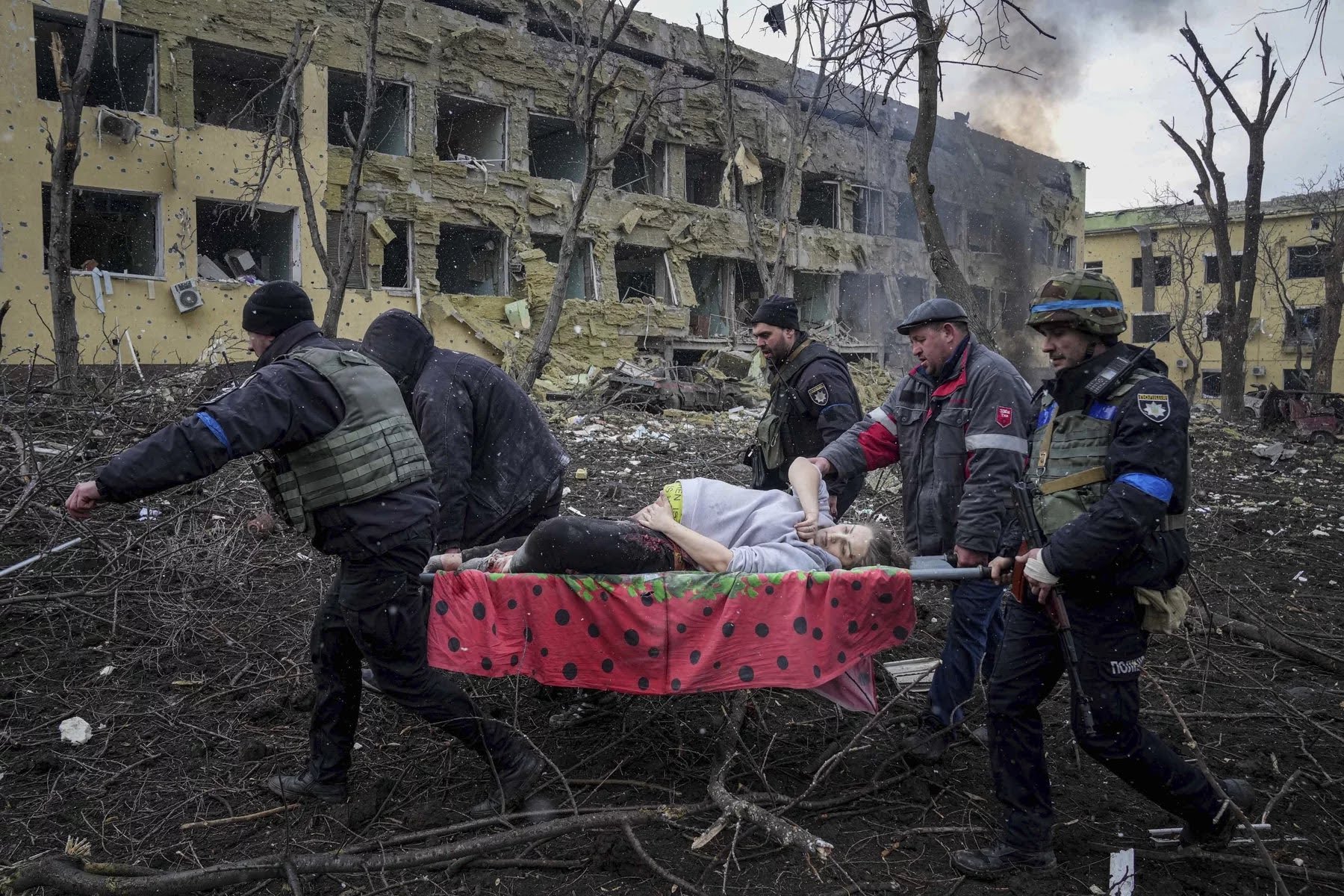
I hear about the buildings destroyed in Lviv and Mariupol and Kyiv and little towns no one outside of Ukraine has ever heard of.  I see footage of mothers carrying their babies through the rubble of destroyed streets, of grandmothers sitting in those streets weeping, of fathers pushing their struggling children into buses that will hopefully save them by taking them to Katowice or Lublin. 

I hear all of this, and I wonder what the people of Russia are thinking.  Are they being lied to by their government?  Are they being told there is no war?  That the Russian soldiers in Ukraine are simply on an extended picnic, and they will be back in their home towns before the first rose blooms this summer.  Or do the Russian people know the truth that there nation is a nation of murderers and rapist and killers of children and their moms and dads and grandparents. 

And I know that this war will not end even when it ends.   

For those that have been in a war, suffered its brutality, endured its grief or succumbed to that grief, war does not end.    

I know this because I saw it in my parents.  They were teenagers when the Germans invaded Poland and did the terrible things to the country and to my mother and father that they did, brutalizing and killing their families and sending them to the slave labor camps in Germany.  

My parents lived with these memories of the war all their lives.  There was never a day that they didn’t carry the psychological wounds of the war with them.  Fifty years after the war, the pain of the terrible things they experienced and saw was still with them.

And it will be like this for the Ukrainians and for those of us watching this war.

—

My latest column for the Dziennik Zwiazkowy, the oldest Polish newspaper in America. 

https://dziennikzwiazkowy.com/felietony2/wojna-toczy-sie-nadal-the-war-goes-on/


.

Friday, March 25, 2022

WAR IS HELL


WAR IS HELL

You’ve probably heard that quote before a million times. You’ve probably been hearing it a lot recently on the news and from your friends because of the terrible things that the Russians are doing to mothers and fathers and children in the Ukraine.

The quote comes from William T. Sherman.  He was a general in the Union Army during the American Civil War, and he knew what he was talking about.  He commanded soldiers in some of the bloodiest conflicts in that war.  He saw soldiers and civilians die in Kentucky, Tennessee, Mississippi, Alabama, and North and South Carolinas.  The worst of the killing was probably in Georgia where he and the Union Army followed a “scorched earth” policy that resulted in the destruction of everything from Atlanta to Savannah.  As he marched to the sea, he destroyed military bases, industrial facilities, and civilian property.  

Let me give you another quote from Sherman: “War is cruelty.”

I’ve been thinking a lot about Sherman’s quotes recently. 

Starting in the morning and throughout the day, I watch the news about the war in Ukraine.  I see the people running from explosions.  I see hospitals and schools and hotels being blown up. I see masses of refugees in train stations struggling to find some way out of the hell that Ukraine has become.  I see mothers frightened, children weeping, fathers looking lost and hopeless.  I see them being killed too. 

War is hell and cruelty.

I watch this on the news and hear about it from my friends, and then I turn back to the things I usually do.  I have toast and cereal for breakfast, I step out into the garden and do some wedding, I go to the supermarket to buy some groceries that I’ll need for tomorrow and the day after. My life continues as it always does.  Putin’s war against Ukraine is just a momentary pause in my day.  Mostly I feel there’s nothing I can do about the terror and the destruction and the cruelty and the hell that the Russians have unleashed on the mother and fathers and children of Ukraine.

The war is constant for those people, and from what I know about how the invasion of Poland by Germany and the Russians affected my parents and the millions of Poles who survived that war, that suffering will never end.

War is hell for the victims of war.  For the rest of us who watch it on TV, it’s just a pause in our regular routines.  

We can talk about how terrible all this killing is.  We can send donations to Doctors Without Borders and the Red Cross.  We can write to our government representatives to do something to stop this war.  We can pray for all this killing to end.

But none of that is enough.  

Nothing is enough. 

War is hell and cruelty.


— my latest column for the Dziennik Zwiazkowy, the oldest Polish newspaper in America.


https://dziennikzwiazkowy.com/felietony2/wojna-to-pieklo-war-is-hell/

.