Tuesday, November 29, 2016

Outside. Leaves. On the Ground.


Outside. Leaves. On the ground.

My granddaughter Lulu was over, and we went outside and gathered a pile of sumac leaves, and then piles of twigs and walnut shells.

We dug a small hole and buried them.

It wasn't a funeral, and so we sang "someone's in the kitchen with Dinah" over and over.

Then we found a couple of brooms and swept the leaves away.

She was hungry then and we came back in and ate some yogurt.

Wednesday, November 23, 2016

Thanksgiving Day Poem


I wrote the following poem to thank my parents and all of my relatives who suffered in World War II.  Some like my parents survived and others didn't.

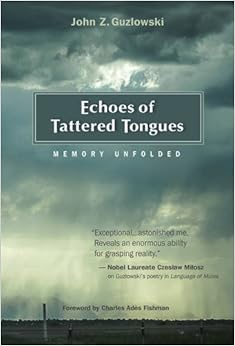
The poem appears in Echoes of Tattered Tongues under the title "My People."

Thanksgiving Day Poem

My people were all Polish people,
the ones who survived to look
in my eyes and touch my fingers
and those who didn’t, dying instead

of fever or hunger or a bullet
in the face, dying maybe thinking
of how their deaths were balanced
by my birth or one of the other

stories the Poles tell themselves
to give themselves the strength
to crawl out of their own graves.

Not all of them had this strength
but enough did, so that I’m here
and you’re here reading this poem
about them. What kept them going?

Maybe something in the souls
of people who start with nothing
and end with nothing, and in between
live from one handful of nothing
to the next handful of nothing.

They keep going--through the terror
in the snow and the misery
in the rain--till some guy pierces
their stomachs with a bayonet

or some sickness grips them, and still
they keep going, even when there
aren’t any rungs on the ladder
even when there aren’t any ladders.

_________________________


My book Echoes of Tattered Tongues contains much of my parents' story of the war years and their lives after they came to the US as Displaced Persons.

Tuesday, November 8, 2016

ELECTION DAY POEM

Election Day Poem

I wanted to post a poem today about the America I know and love.

It's an America of refugees and immigrants, people who came here with nothing and struggled to get the things they had.

Here's the poem, from my Echoes of Tattered Tongues book.

My People

My people were all poor people,
the ones who survived to look
in my eyes and touch my fingers
and those who didn’t, dying instead

of fever, hunger, or even a bullet
in the face, dying maybe thinking
of how their deaths were balanced
by my birth or one of the other

stories the poor tell themselves
to give themselves the strength
to crawl out of their own graves.

Not all of them had this strength
but enough did, so that I’m here
and you’re here reading this poem
about them. What kept them going?

Maybe something in the souls
of people who start with nothing
and end with nothing, and in between
live from one handful of nothing
to the next handful of nothing.

They keep going—through the terror
in the snow and the misery
in the rain—till some guy pierces
their stomachs with a bayonet

or some sickness grips them, and still
they keep going, even when there
aren’t any rungs on the ladder,
even when there aren’t any ladders.

Monday, October 31, 2016

All Souls Day

When I was a child growing up in Chicago, All Souls Day wasn't a big deal. But in Poland it was.  At least that's what my parents said.  They would tell me stories about what it was like in Poland when they were kids.

People, my mother would say, would walk to the cemeteries where their mothers and fathers, sisters and brothers, were buried and leave fall flowers and lighted candles there. Some times at night, there would be so many candles burning on and near the graves that you could see the light shining above the cemeteries as you walked back home, even if your home was far away.


But we didn't do that in America. We were Displaced Persons, immigrants, and all our dead were buried far away in Poland. My mother didn't even know where her mother and her sister and her sister's baby were buried. The men who killed them put my mother on a boxcar and sent her to the slave labor camps in Germany before she could bury her family. It was a bad time.

A little while ago, the Polish-American poet Oriana Ivy sent me a poem about All Souls Day, and she said it would be okay to share it with people.

Here's the poem:

All Souls


Sometimes I think Warsaw fog
is the dead, come back

to seek their old homes –
wanting to touch even the walls.

But they cannot find those walls,
so they embrace the trees instead,

lindens and enduring chestnuts.
They embrace the whole city, lay

their arms around the bridges
and the droplet-beaded street lamps;

they pray in the Square of Three Crosses,
kneel among the candles and flowers

under bronze plaques that say
On this spot, 100 people were shot –

they bow, they kiss
even the railroad tracks –

they do not complain, only hold
what they can, in unraveling white.

-- Oriana Ivy

_______

If you want to read more of Oriana's poems, she has a new book out called April Snow, the winner of the New Women's Voice Poetry Award.  Some of her poems are available online at the journal qarttsiluni. She blogs about life and poetry at Oriana Poetry.

If you want to know more about Polish and Polish-American All Souls Day, Deacon Konicki's blog has a post about the way it is celebrated in Poland and Robert Strybel has a piece on the way the day is commemorated by Polish-Americans in the US.

By the way, the Polish-American community in Buffalo, NY, has organized an All Souls Day commemoration. There's an article about it in the Polish News.

A piece by Anna Maria Mickiewicz about an observance in England is available here.

The photo is of an All Souls Day commemoration in Poland.

Friday, October 28, 2016

My Mother's Dreams in Wartime


My Mother's Dreams in Wartime

The world burns before our eyes,
and the smell of everything red
is on our skin.
We wait in line for bread
that never comes. We speak
to strangers thinking they will
tell us where our lives are.
We pray in the barracks
and the fields for the miracle
of hope.

____________________________

My mother survived more than 2 years in various labor and concentration camps in Germany.  She never thought she would.

Much of the writing in my book Echoes of Tattered Tongues describe her struggle to keep going.  

Friday, October 14, 2016

Audible Version of Echoes of Tattered Tongues

My book Echoes of Tattered Tongues, a memoir about my parents and their lives as Polish slave laborers in Germany and as refugees, has recently been published as an Audible book.
There are some free samples at the link below.
For me the most interesting thing was how the actor Jon Brandi made the book feel like a coherent and whole narrative rather than a series of poems and prose pieces.

Thursday, October 13, 2016

Me and Thoreau and My Dad


Thoreau is an author I love. 

When my daughter was a kid, I would reel out these Thoreau quotes on every occasion whether we were making vegetable soup or going to a funeral.  I would have a quote, and I always acknowledged my quotes.  "Like Thoreau used to say ..."

I thought I was giving her gospel that would help her in all circumstances.  It would be the universal clock that Melville writes about somewhere--right in all longitudes and latitudes.
I was wrong--but have never learned how wrong.

I keep teaching Thoreau and expecting students to say, "Yeah, this makes sense."
They never say that.

For years I taught Thoreau's Walden.  All of Walden.  Whenever I could. Students hated him. Hated it.

He goes so much against their grain, and against the grain of any practical person. 
I was reading a review in the New Yorker about some book from Oxford U Press about technology in the 19th century, and the reviewer points out that Thoreau was the anti-modern.  The whole world wants to go forward into the 20 century and then the 21 century--except Thoreau.  He wants to take us all back to the 18th century!

People don't want to be farmers--lead simple lives.

Let me tell you a story and then I'll stop.

My father grew up on a farm in Poland--my mother did too.  My dad then spent 5 years in Germany as a Slave Laborer, and 6 years as a refugee.  When he and my mom finally came to America, they were offered the opportunity to work on a farm in upstate New York, make a living and settle there.  They stayed on the farm there long enough to pay off their passage over from Germany.  

Then, they moved to Chicago (3 million people, coal dust in the air, not a cow in sight [they have some now at Lincoln Park Zoo]).  My parents worked in factories, double shifts, never took vacations.  There was nothing rural/bucolic about their lives there.  I once asked them, "Why didn't you stay on the farm in Upstate New York?  The trees the cows the quiet"

My mother said, "Are you kidding?"

Working a shift and a half everyday in a factory where melting plastic burnt your arms and chemicals scarred your lungs was better than working on a farm.

________________________

PS

I know I could never live on a farm.  Not now.  It's no country for old men.  I can barely keep track of the garden in my backyard, the leaves of grass in my front.  

But I know I can still read Thoreau, and dream about the forests beyond the garden in my backyard.  

_____________

The photo is one I took of Walden Pond about 10 years ago on a Saturday afternoon in early September.