Showing posts with label Poland. Show all posts

Friday, March 30, 2018

Easter Poem


My father wasn't an educated man.  He was born on a small farm in western Poland and never attended school.  He used to joke that the German concentration camp he spent 4 years in was his college and university.

He didn't know much about stuff most of us take for granted.  One of the things he didn't know much about was religion.  You couldn't talk to him about things like Moses or the Garden of Eden or the Holy Trinity, even though he was born a Catholic.

But he had a strong faith, and there were things that he believed with a certainty as sure as the turning of the earth.   This is a poem about that.

What My Father Believed 

He didn’t know about the Rock of Ages
or bringing in the sheaves or Jacob’s ladder
or gathering at the beautiful river 
that flows beneath the throne of God.
He’d never heard of the Baltimore Catechism
either, and didn’t know the purpose of life 
was to love and honor and serve God.

He‘d been to the village church as a boy 
in Poland, and knew he was Catholic
because his mother and father were buried 
in a cemetery under wooden crosses. 
His sister Catherine was buried there too. 

The day their mother died Catherine took 
to the kitchen corner where the stove sat,
and cried.  She wouldn’t eat or drink, just cried
until she died there, died of a broken heart.
She was three or four years old, he was five.

What he knew about the nature of God 
and religion came from the sermons
the priests told at mass, and this got mixed up
with his own life.  He knew living was hard, 
and that even children are meant to suffer.  
Sometimes, when he was drinking he’d ask,
“Didn’t God send his own son here to suffer?”

My father believed we are here to lift logs
that can’t be lifted, to hammer steel nails
so bent they crack when we hit them.
In the slave labor camps in Germany,
He’d seen men try the impossible and fail.

He believed life is hard, and we should
help each other.  If you see someone 
on a cross, his weight pulling him down 
and breaking his muscles, you should try 
to lift him, even if only for a minute,
even though you know lifting won’t save him.

_____________________________

The poem is taken from my book about my dad and my mom and their experiences in WWII, Echoes of Tattered Tongues, available from Amazon.

The illustration at the top of the page is by the artist Voytek Luka from my book Third Winter of War: Buchenwald.

Wednesday, September 27, 2017

Charity in America


When we first arrived in Chicago in 1952, we were lost.

We had spent 6 years in the DP camps in Germany and another year outside of Buffalo, NY, working for a farmer who paid our passage over.

But now we were in Chicago, and we were lost.

We had nothing, just the things we brought with us from Germany, some plates, a crucifix, a wooden comb, some goose down pillows, a frying pan, and letters from a friend in America.

In Chicago we lived in dark rooms in small apartments that we shared with other DP families from the camps in Germany.  We were all people who had left everything behind, our mothers and fathers, our grandparents, our brothers and sisters.

We were alone and didn't know where anything in this new world was.  I remember one time my father went out looking for a store where he could buy some Polish sausage and my mom said to him, "Maybe they don't have kielbasa here."

I was 4 years old that first winter in America, and I remember staring out a window at the snow falling on the buses moving slowly up and down Milwaukee Avenue, and begging my father to take us back to the refugee camps in Germany.

We were lost in America -- but sometimes people helped us.

We didn't know who they were, what their names were, or why they helped us.  But they did.

Here's a poem I wrote about those people who helped us in Chicago during that first winter.

Charity

The women who came to our apartment
didn't speak Polish, and the only English
my parents knew was "Thank you, Missus,"
but they came and brought dresses for my mom,
rubber boots for my dad, cans of pork and beans
and loaves of bread for all of us,
and for my sister and me, comic books
and sometimes a hard rubber toy, a doll
or a red truck with a missing tire.

We didn't know who they were or how
they'd found us or even their real names.
But they had names: "dobra" and "fajna,"
and we knew what those words meant.
These were "good" and "fine" women.

____

The poem is from my book about our refugee experience, Echoes of Tattered Tongues.

Wednesday, July 12, 2017

My Mother and Her Neighbors


Tens of thousands of Poles in Eastern Poland were killed between 1943 and 1944 by Ukrainian Nationalists working with their German colleagues.  July 11 was the day of the worst killing, a day when the Nationalists attacked 100 or so villages.  That was seventy-four years ago.

My mother's family was killing during this period by her Ukrainian neighbors.  Her mother was murdered, her sister was raped and killed, her sister's baby kicked to death.  My mother, a girl of 19 at the time, was able to survive by breaking through a window and running into a forest to hide.  She was found a couple days later and taken to a slave labor camp in Germany.  She spent the next 2 years in those camps.

My mom and my dad went back to her village in 1988 to see if she could find the graves of her mom and sister and the sister's baby.  There were no graves.  The men who did the killing didn't take the time to dig graves and put up crosses or markers.

During that trip, my mom made it to her old house, the one where the killing took place.  She knocked on the door and when someone answered her knocking, she introduced herself and told them that she had lived in this house when she was a girl, before the killings.

The person who answered the door, a Ukrainian fellow about my mom's age, said that he had been living in the house all his life and he didn't know her and didn't know what she was talking about.

My mom left and never went back.

I haven't written a lot about my mom and her Ukrainian neighbors, but I have written two poems.

The first is called "My Mother was 19," and it's about the day the Nazis and her neighbors came to her house and did their killing.

The second poem is "My Mother's Neighbors." It's a poem of mine that has never been published.  It tells about what the killers did after they left my mom's house.

My Mother was 19

Soldiers from nowhere
came to my mom’s farm
killed her sister Genja’s baby
with their heels
shot her momma too

One time in the neck
then for kicks in the face
lots of times

They saw my mother
they didn’t care
she was a virgin
dressed in a blue dress
with tiny white flowers

They raped her
so she couldn’t stand up
couldn’t lie down
couldn’t talk

They broke her teeth
when they shoved
the blue dress
in her mouth

If they had a camera
they would’ve taken her picture
and sent it to her

That’s the kind they were

Let me tell you:
God doesn’t give
you any favors

He doesn’t say
now you’ve seen
this bad thing
and tomorrow you’ll see
this good thing
and when you see it
you’ll be smiling

That’s bullshit

_____________________

My Mother’s Neighbors

Their clothes are wet and cold with the blood
of the baby and the women they helped the Germans
kill in the barn.  But they won’t remember that.

They’ll only remember this walk home, the snow
falling fast around them, muting the clicking trees
and silencing the birds.  They will remember

their slow talk, the old men going on about
how the potatoes they gathered this year
could never match the weight of last year’s harvest

the young men trying to hide their joy 
by whispering about the village girls
and what they have seen beneath their dresses.

Later they will all be home.  Already their wives
And mothers watch for them at the windows,

Afraid the snow will catch them far from home.

___________________________________

I've posted a lot of blogs about my mom over the years.  This is a recent one about remembering her on the anniversary of her death: Remembering My Mom.

If you want to read more about the massacre, here is a wikipedia piece.

If you want to read more about my mom and dad, my book Echoes of Tattered Tongues is available from Amazon.  Just click here.

Monday, July 10, 2017

Dreams of Warsaw, 1939


The First Poem I Wrote about My Parents

I've been writing poems for about 37 years now.  I started when I was in grad school at Purdue working on my Ph.D.  It was a hot, humid August afternoon, and I was sitting at a desk thinking about Faulkner, trying to make sense of a line of imagery that seemed to thread through all of his novels.  I wasn't having any luck.

Out of nowhere, I had this sense of my parents and where they were and what they were doing.

It came as a shock this sense.  I hadn't  lived at home in almost a decade, seldom saw my parents, tried in fact not to think about them and their lives.  I didn't want to know about their worries, their memories of WWII and the slave labor camps and the mess those memories were making of their lives.   But suddenly there they were in my head, and for some reason I started writing about them.

I hadn't written a poem in at least a decade either, but there suddenly I was writing a poem.  And it wasn't the last.  This poem about my parents started me writing poems again, and I've never stopped.

Here's the poem:

Dreams of Poland, September l939

Too many fears
for a summer day
I regulate my thoughts
and my breathing
regard the humidity
and dream

Somewhere my parents
are still survivors
living unhurried lives
of unhurried memories:
the unclean sweep of a bayonet
through a young girl's breast,
a body drooping over a rail fence,
the charred lips of the captain of lancers
whispering and steaming
"Where are the horses
where are the horses?"

Death in Poland
like death nowhere else‑‑

cool, gray, breathless

__________________

The poem appears in Echoes of Tattered Tongues.

The illustration above is by the Polish artist Voytek Luka.  It was done as an illustration for my book Third Winter of War: Buchenwald.

Wednesday, June 14, 2017

All of History's Polacks


"All of History's Polacks"
I'm going to do a presentation today at the annual conference of Holocaust Educators of Virginia.
One of the things I'm talking about is what it was like for us as refugees in Germany for 6 years and what it was like when we came to America finally.
I'm going to start my presentation by reading from the preface to Echoes of Tattered Tongues:
Where I’m Coming From
I never set out to write about my parents and their experiences in the concentration camps in Germany and what it was like for us as immigrants here in America. When I was growing up, I wanted to get as far as possible away from them and the world they came from.
When we landed at Ellis Island, we were unmistakably foreign. We didn’t speak English. We dressed in black and brown wool that had been given to us by a UN relief agency. My mother wore a babushka on her head, my father a woolen cloth cap with a broken brim. They both wore their best shoes, leather boots that came to their knees. My mother’s brother had stitched and hammered those boots by hand. All our belongings were gathered together in a small steamer trunk my dad had built.
Our lives were hard: America then—like now—didn’t much want to see a lot of immigrants coming over and taking American jobs, sharing apartments with two or three other immigrant families, getting into the kinds of trouble immigrants get into. We were regarded as Polacks—dirty, dumb, lazy, dishonest, immoral, licentious, drunken Polacks.
I felt hobbled by being a Polack and a DP, a Displaced Person. It was hard karma.
I started running away from my Polishness as soon as I could, and for much of my life I continued to run. As I started moving into my early teens, I didn’t want anything to do with my Polish parents and their past. I thought of it all as that “Polack” or immigrant past. It was so old world, so old-fashioned. I had parents who couldn’t speak English, couldn’t talk about baseball or movies, didn’t know anything about Elvis Presley or Marilyn Monroe or James Dean, couldn’t spend a night without arguing with each other in Polish, the language of misery, poverty, and alienation. I wanted to spend as little time as possible thinking about my parents and their Polishness and what my mother sometimes called “that camp shit.”
I moved away from them, physically and psychologically and emotionally and culturally and intellectually. I stopped going to church, I left home, I didn’t maintain my Polishness, I stopped talking Polish, I stopped eating Polish food, I went to grad school, I immersed myself in American culture. I studied Emerson, Whitman, Thoreau, Dickinson, Eliot, John Dos Passos, Eugene O’Neill, Fitzgerald, and on and on.
I became the person my parents didn’t want me to be. They wanted me to be a good Polish boy, living Polish, going to church, residing at home, dreaming of returning to Poland like my dad.
I guess I did what some immigrant kids always do. I said, your world is not my world.
And then it all changed: I started writing about my parents when I was in grad school. Maybe it was because I had finally gotten far enough away from them. Maybe not.
I realized very quickly that even if people don’t want to read what I write, I had to write my poems about my parents just to make sure someone would. Really, there just aren’t a lot of people writing about people like my parents and the other DPs. And if I don’t write, who will? Imagine all of those hundreds of thousands of Poles who came to this country as DPs. Who wrote for them?
I sometimes feel that I am writing for all the people who’ve sought refuge in America, whose stories were never told, whose voices got lost somewhere in the great cemetery of the 20th century—that I have an obligation to listen to those voices and give them a place to be heard, to tell the stories they would write themselves if they could. For the last thirty-five years, while I have been writing about my parents’ lives, I sometimes think that I am not only writing about their lives, but also about the lives of all those forgotten, voiceless refugees, DPs, and survivors that the last century produced, no matter where they came from.
All of history’s “Polacks.”

Monday, October 31, 2016

All Souls Day

When I was a child growing up in Chicago, All Souls Day wasn't a big deal. But in Poland it was.  At least that's what my parents said.  They would tell me stories about what it was like in Poland when they were kids.

People, my mother would say, would walk to the cemeteries where their mothers and fathers, sisters and brothers, were buried and leave fall flowers and lighted candles there. Some times at night, there would be so many candles burning on and near the graves that you could see the light shining above the cemeteries as you walked back home, even if your home was far away.


But we didn't do that in America. We were Displaced Persons, immigrants, and all our dead were buried far away in Poland. My mother didn't even know where her mother and her sister and her sister's baby were buried. The men who killed them put my mother on a boxcar and sent her to the slave labor camps in Germany before she could bury her family. It was a bad time.

A little while ago, the Polish-American poet Oriana Ivy sent me a poem about All Souls Day, and she said it would be okay to share it with people.

Here's the poem:

All Souls


Sometimes I think Warsaw fog
is the dead, come back

to seek their old homes –
wanting to touch even the walls.

But they cannot find those walls,
so they embrace the trees instead,

lindens and enduring chestnuts.
They embrace the whole city, lay

their arms around the bridges
and the droplet-beaded street lamps;

they pray in the Square of Three Crosses,
kneel among the candles and flowers

under bronze plaques that say
On this spot, 100 people were shot –

they bow, they kiss
even the railroad tracks –

they do not complain, only hold
what they can, in unraveling white.

-- Oriana Ivy

_______

If you want to read more of Oriana's poems, she has a new book out called April Snow, the winner of the New Women's Voice Poetry Award.  Some of her poems are available online at the journal qarttsiluni. She blogs about life and poetry at Oriana Poetry.

If you want to know more about Polish and Polish-American All Souls Day, Deacon Konicki's blog has a post about the way it is celebrated in Poland and Robert Strybel has a piece on the way the day is commemorated by Polish-Americans in the US.

By the way, the Polish-American community in Buffalo, NY, has organized an All Souls Day commemoration. There's an article about it in the Polish News.

A piece by Anna Maria Mickiewicz about an observance in England is available here.

The photo is of an All Souls Day commemoration in Poland.

Sunday, January 13, 2013

Remembering My Mom


My mother died seven years ago this January 18.  She died in a hospice in Sun City, Arizona.  

When she died, we had her funeral service near Darien, Illinois, where my sister Donna lives.  She made the arrangements for the services and the burial later up in Niles, Illinois, at St. Adalbert's Cemetery.

The priest who was going to perform the service was Father Bob, and he didn't know my mom at all so I offered to send him some information about her.  

Here's the letter I sent him: 

Dear Father Bob,

My sister Donna tells me that you will be doing the memorial service for my mother Teresa Guzlowski, and that you might like some information about her.

I’m not sure what my sister told you.  But here are some things I know about my mom. 

My mother was born in a village west of Lvov in Poland in 1922.  She lived there with her mother and father and sisters and brothers.  Her dad was a forest warden and they lived a quiet, peaceful life.  She liked telling stories of what it was like being a kid living near a forest.  She liked to pick mushrooms and sing and ride her pet pig Caroline.  She liked to joke that the pig Caroline was smarter than her brothers.

This all changed of course when World War II started.  In 1942, she was taken to a Nazi concentration camp in Germany.  She left behind her mother, his sister and her sister’s baby, all killed by the Nazis and those who collaborated with them. 

For the next 3 years she worked on the farms connected to the Buchenwald Concentration District.  She worked in the fields and the barns.  She said it wasn’t a death camp, but rather a slow death camp.  And she used to say that a lot of the pain she felt later in life in her legs and back came from work she did in those camps. 

When the war ended in 1945, she married my father Jan who had also been a slave laborer, and the two of them lived in refugee camps in Germany until 1951.  That year my parents, my sister and I were allowed to immigrate to America.

When we first got to the US, my parents and my sister and I worked on a farm in upstate New York to pay off part of the money that it cost to bring us to the states.

My mother once told me a funny story about this time. 

My sister and I were 5 and 3 years old respectively.  But we were still expected to work.  One time we were picking straw berries and we started complaining how hard the work was.  We started crying and begging our parents to let us go back to Germany and the refugee camps.  Life, we said, was easier there.  My mother told us that this was America and we had to stay here.

After putting in a year on the farm, we came to Chicago and lived in the Polish areas along Milwaukee Avenue.  Both of my parents worked hard.  My mom worked in a factory, in a molding room where she would work with hot plastic.  The plastic would be pressed into a mold to make telephone and such.  She would come home from work with burns on her arms from the plastic.

When she died, the scars were still on her hands and arms.  I bet if you look in the coffin you will see them still.

Both my parents worked hard at minimum wage jobs.  My mother often worked the midnight to 8 in the morning shift, so she could be around when we were home.  But their hard work paid off, and they were able to buy a house and to send my sister and me to Catholic grade schools and high schools.  This education gave me a love for learning that I’ve never lost and that led me to get a Ph.D. in English Literature and to spend my life teaching others and trying to convey to them what my parents taught me about the value of an education.

My parents retired to Arizona in the early 90s, and my dad died there in 1997.  Since then my mother lived alone, taking care of herself.  She was fiercely independent and didn’t want to be beholding to anyone.  When she went into the hospital that last time, she was still living alone, even though she could hardly stand and every step took effort that would break some one with less resolve.

In summary, what I would like to say about my mom is that she was a very very strong person.  She survived the camps and she survived a life of working on factory assembly lines and in skyscrapers where she cleaned offices from midnight until 8 in the morning taking out other people’s garbage and polishing the stains off of their desks.  And she survived the sometimes turbulent relationship she had with my dad and my sister and me.

If you could have seen her when she was dying, you would have seen that same desire to go on, to survive, even when there was little hope that she would ever be able to walk or talk or hear or breathe the way she had before her strokes.  For the last two years, when she and I talked, she would often say, “Johnny, how can I live without hope?” 

I don’t know how she did it—but she did.  She lived without hope.

This isn’t to say that she was a saint.  A lot of times when we think about those who die, especially when they suffered so much in the concentration camps and had seen so much suffering in their own lives, we want to eulogize them, talk about what was good and blessed in their lives; but my mother wasn’t the kind of person who would want us to turn from the truth.  And the truth here was that her experiences and her suffering made her hard and made her cold.  I sometimes think that she may have survived the war but what she left back in the camps was her heart. 

Here’s a poem I wrote about her:


What the War Taught Her

My mother learned that sex is bad,
Men are worthless, it is always cold
And there is never enough to eat.

She learned that if you are stupid
With your hands you will not survive
The winter even if you survive the fall.

She learned that only the young survive
The camps.  The old are left in piles
Like worthless paper, and babies
Are scarce like chickens and bread.

She learned that the world is a broken place
Where no birds sing, and even angels
Cannot bear the sorrows God gives them.

She learned that you don't pray
Your enemies will not torment you. 
You only pray that they will not kill you.

_______________________________


My book Lighting and Ashes tells the story of my parents.  You can also read some other blogs about my mom and dad:  

An earlier post about the day my mom died.  

Two Lives Shaped by World War Two: A Video

Valentine's Day: A World War Two Love Story


Wednesday, June 6, 2012

Remembering D-Day: June 6, 1944


Today, June 6, is the anniversary of the Allied invasion of Europe.  It's a day that means a lot to me.  My parents were two of the millions of people who were swept up by the Nazis and taken to Germany to be slave laborers.  My mom  spent more than two years in forced labor camps, and my day spent four years in Buchenwald Concentration Camp.  Like almost every other Pole living in Europe at that time, they both lost family in the war.  My mom's mom, sister and infant niece were killed when the Germans came to her village.  After the war both my parents lived in refugee camps for six years before they were allowed to come to the US.  My sister and I were born in those refugee camps.  June 6, 1944 was the day that long process of liberation for all of us began.

I've written a lot about my parents and their experiences, and here are two poems from my book Lightning and Ashes about those experiences.  The first poem is about what the war taught my mother; the second is about the spring day the Americans liberated my dad and the camps he was in:


What the War Taught Her


My mother learned that sex is bad,
Men are worthless, it is always cold
And there is never enough to eat.

She learned that if you are stupid
With your hands you will not survive
The winter even if you survive the fall.

She learned that only the young survive
The camps.  The old are left in piles
Like worthless paper, and babies
Are scarce like chickens and bread.

She learned that the world is a broken place
Where no birds sing, and even angels
Cannot bear the sorrows God gives them.

She learned that you don't pray
Your enemies will not torment you. 
You only pray that they will not kill you.


In the Spring the War Ended

For a long time the war was not in the camps.
My father worked in the fields and listened
to the wind moving the grain, or a guard
shouting a command far off, or a man dying.

But in the fall, my father heard the rumbling
whisper of American planes, so high, like
angels, cutting through the sky, a thunder
even God in Heaven would have to listen to.

At last, one day he knew the war was there.
In the door of the barracks stood a soldier,
an American, short like a boy and frightened,
and my father marveled at the miracle of his youth

and took his hands and embraced him and told him
he loved him and his mother and father,
and he would pray for all his children
and even forgive him the sin of taking so long.

_______________________________

Here's a link to a presentation I gave at St. Francis College about my parents and their experiences in World War II: Just click here.

My daughter Lillian sent me the following link to color photos from before and after D-Day from Life Magazine. The photos are amazing, and a large part of that amazement comes from the color. The color gives me a shock, a good one--it takes away the distance, makes the photos and the people and places in them immediate in a profound way.

Here's the link: Life.

Thursday, September 2, 2010

Sept. 1, 1939: The Day World War II Started


On September 1, 1939, the Nazis invaded Poland. In those first days and the six years that followed, more than five million Poles died.

I've written a number of poems about the first days of the war and what happened to Poland, but none of those poems ever captured, I felt, the struggle of the Polish people to throw off the Nazi invasion.

A couple of years ago, I tried again to describe what my parents and the Poles of their generation felt. Here's the poem:


Landscape with Dead Horses

1.

War comes down like a hammer, heavy and hard
flattening the earth and killing the soft things:
horses and children, flowers and hope, love
and the smell of the farmers’earth, the coolness
of the creek, the look of trees as they uncurl
their leaves in late March and early April.
You smell the horses before you see them.

2.

Horses groan, their heads nailed to the ground
their bodies rocking crazily, groaning
like men trying to lift their heads for one
last breath, to breathe, to force cold air
into their shredded, burning lungs.
For these horses and the men who rode them,
this world will never again be the world
God made; and still they dare to raise their heads,
to force the air into their shredded lungs.

3.

Look at this horse. Its head torn from its body
by a shell. So much blood will teach you more
about the world than all the books in it.
This horse’s head will remake the world for you—
teach even God a lesson about the stones
that wait to rise in our hearts, cold and hard.

4.

In the end Hitler sat in his cold bunker
and asked his generals about his own horses,
“Where are they?” He asked, “Where are my horses?”
And no one dared to tell him, “They are dead
in the fields with the Poles and their horses,
bloated with death and burning with our corpses.”

________________________________________________

This poem originally appeared in War, Literature, and the Arts along with several other poems I wrote about Poland and the war. Here's a link to those poems. Click here.

By the way, in that same issue of WLA, there are also poems about war by Polish-American writers John Minczeski and Lisa Siedlarz.

Click here for my previous post on September 1, 1939.
________________________________________________

The photograph of re-enactors in 1939 uniforms was taken by Mr. Mazowieckie at a re-enactment of the Bzura River Battle.

Monday, February 1, 2010

Waiting to Be Heard: Lilka Croydon-Trzcinska

In her book Waiting To Be Heard: The Polish Christian Experience Under Nazi and Stalinist Oppression 1939-1955, Bogusia Wojciechowska brings together the stories of many Poles who experienced Nazi and Stalinist brutality.

One of the most moving stories is that of Lilka Croydon-Trzcinska. She was still in high school when the Nazis invaded, and she and her sisters and brother joined the Polish Resistance. For her activities, the Nazis sent her first to Auschwitz and then to the Bergen-Belsen concentration camp. After the war, she wrote about her experiences in a book entitled The Labyrinth Of Dangerous Hours: A Memoir Of The Second World War (with a forward by historian Norman Davies).

Dr. Bogusia Wojciechowska has allowed me to post a video of part of her interview with Lilka Croydon-Trzcinska.


___________

To read my earlier post on Waiting to Be Heard click here.

Saturday, October 31, 2009

All Souls Day

When I was a child growing up in Chicago, All Souls Day wasn't a big deal. My parents would tell me stories about what it was like in Poland when they were kids.

People, my mother would say, would walk to the cemeteries where their mothers and fathers, sisters and brothers, were buried and leave fall flowers and lighted candles there. Some times at night, there would be so many candles burning on and near the graves that you could see the light shining above the cemeteries as you walked back home, even if your home was far away.


But we didn't do that in America. We were Displaced Persons, immigrants, and all our dead were buried far away in Poland. My mother didn't even know where her mother and her sister and her sister's baby were buried. The men who killed them put my mother on a boxcar and sent her to the slave labor camps in Germany before she could bury her family. It was a bad time.

A little while ago, the Polish-American poet Oriana Ivy sent me a poem about All Souls Day, and she said it would be okay to share it with people.

Here's the poem:

All Souls


Sometimes I think Warsaw fog
is the dead, come back

to seek their old homes –
wanting to touch even the walls.

But they cannot find those walls,
so they embrace the trees instead,

lindens and enduring chestnuts.
They embrace the whole city, lay

their arms around the bridges
and the droplet-beaded street lamps;

they pray in the Square of Three Crosses,
kneel among the candles and flowers

under bronze plaques that say
On this spot, 100 people were shot –

they bow, they kiss
even the railroad tracks –

they do not complain, only hold
what they can, in unraveling white.

-- Oriana Ivy

_______


_______

If you want to read more of Oriana's poems, she has a new book out called April Snow, the winner of the New Women's Voice Poetry Award.  Some of her poems are available online at the journal qarttsiluni. She blogs about life and poetry at Oriana Poetry.

If you want to know more about Polish and Polish-American All Souls Day, Deacon Konicki's blog has a post about the way it is celebrated in Poland and Robert Strybel has a piece on the way the day is commemorated by Polish-Americans in the US.

By the way, the Polish-American community in Buffalo, NY, has organized an All Souls Day commemoration. There's an article about it in the Polish News.


_______

The photo is of an All Souls Day commemoration in Poland.

Tuesday, October 6, 2009

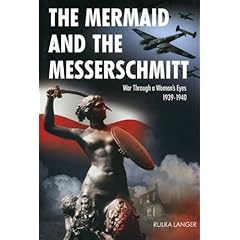
The Mermaid and the Messerschmitt: War Through a Woman's Eyes, 1939-1940


I've been looking forward to this memoir by Rulka Langer for a very long time. It's the first publication of Aquila Polonica, a new press started by Terry Tegnazian and Stefan Mucha dedicated to publishing works about the Polish World War II experience in English. The press hopes to publish firsthand accounts, memoirs, poetry, literature, photographs, artwork and historical studies. Terry Tegnazian has written that what inspires her is Poland's role in World War II. It is, she says, "possibly the most heroic and tragic of all the Allies, yet remains one of the least-known aspects of WWII to those living in the West. It is our mission to bring this amazing story to the wider English-speaking world."

Aquila Polonica's The Mermaid and the Messerschmitt: War Through a Woman’s Eyes, 1939-1940 is a rare eyewitness account of the first six months of WWII – the Nazi German invasion of Poland, the Siege of Warsaw, and the first months of the Nazi occupation – written by Rulka Langer, a civilian, a young Polish career woman and mother, who was a graduate of Vassar College in the U.S.

Her story is enhanced by the historic photographs, documents, and maps that the publishers have gathered together especially for this volume.

The book has been chosen as a selection of the Book-of-the-Month Club, the History Book Club, and the Military Book Club, and is endorsed by Dr. Zbigniew Brzezinski. Publishers Weekly calls it “an unusual take on WWII.”

The recently retired head of the Los Angeles Public Library system read it and says: “I couldn’t put the book down. Her story is riveting … utterly contemporary and compelling.”

The Mermaid is available in hardcover at your local bookstore (if it’s not in stock, they can order it for you), or online at Amazon.com.

Wednesday, September 16, 2009

Waiting to Be Heard: The Polish Christian Experience Under Nazi and Stalinist Oppression 1939-1955


I first met Dr. Bogusia Wojciechowska over the internet about five years ago. Someone sent me a note about her and her work, and I got in touch with her as soon as I read it.

She was working on an extensive research project to document the lives of Poles who were forced to leave Poland during World War II. This was a project that touched me directly. For years, I've try to find books that would tell me more about what happened to people like my parents who had been rounded up by the Germans and taken to the slave labor and concentration camps in Germany. What I found surprised me. Beyond Richard C. Lukas's excellent Forgotten Holocaust there weren't many such books, and his book in fact didn't tell me what I wanted to know about the lives of the Poles who were taken to German and those -- like my Uncle Jan -- who were taken to Siberia.

It seemed that what my mom once said was true. They don't make books about people like us.

Dr. Wojciechowska's project has attempted to change that. Over the years, as a historian, she devoted herself to chronicling the experiences of those who were forced to leave Poland. Her website -- The Polish Diaspora -- has been an essential source of information about those experiences. Now, she has edited a book that brings together much of her research about the lives of those who were taken from Poland during the war.

The book is called Waiting to Be Heard: The Polish Christian Experience Under Nazi and Stalinist Oppression 1939-1955 .

If my mom were to see this book, she would probably say, "At last, here's a start."

Here's a press release from the publisher of Waiting to Be Heard:


Polish Christian survivors of WWII oppression

All wars disrupt; they leave behind the dead and the living, the victims and the survivors. The war that tore apart Poland in 1939 with Hitler’s avowed annihilation of an eastern neighbor "for German expansion", Stalin’s westward thrust with Soviet communism and the mass deportation to Siberia of whole societies, all ensured that while millions died, those who survived could not or would not speak of their ordeal. Theirs was the story of deprivation and of humiliation; it was the realization that not only was a homeland lost, but that an entire future was denied.

Waiting To Be Heard (The Polish Christian Experience Under Nazi and Stalinist Oppression 1939-1955) is an attempt to give voice to those who, in fear of their lives or in anticipation of an eventual and triumphant return, found themselves exiled across the world. Dr. Bogusia Wojciechowska, the daughter of a couple that found refuge in a camp outside Oxford, England, and now Dean at Bunker Hill Community College in Boston MA, had an incomplete picture of her family’s plight until she chanced upon some letters written by her grandfather. Her training as a historian gave her the confidence and the methodology to conduct over one hundred interviews with a rapidly decreasing population that had first-hand experience of both Nazi and Stalinist oppression. In the majority of cases these interviews were the first time this diaspora had spoken at length about their suffering and their determination to secure freedom for their homeland.

Presented as a series of vignettes, Waiting to Be Heard is a chronology punctuated by the poetry of a subsequent generation that includes Martin Stepek, John Guzlowski, and Hania Kaczanowska, each of whom pay respectful and heart-rending homage to the dignity of their parents. This 400-page book contains many photographs and artifacts, and has a foreword by Ryszard Kaczorowski, former president of the Polish Government-in-Exile in London who, in 1990, was finally able to hand over the safeguarded State Insignia to the newly and democratically-elected president, Lech Walesa, in Warszawa.

Published this September, by AuthorHouse, Waiting To Be Heard is printed to order, so wait times may vary. Please order through Amazon, and Barnes & Noble websites, or through your local bookstore. Meanwhile, one can get a feel for the content by visiting www.PolishDiaspora.com. The ISBN is 978-1-4490-1370-7

For additional information, write to: WaitingToBeHeard(at)comcast.net -- substitue @ for (at).

Monday, September 14, 2009

Poland to Buffalo Through World War II

 
Posted by Picasa


I recently received the following information regarding the upcoming conference (Oct. 3-4) sponsored by the Andy Golebiowski and the Polish Legacy Project of Buffalo, NY:

Untold Stories Come Alive

This year marks the 70th anniversary of the invasion of Poland by Nazi Germany and the Soviet Union; the start of WWII. The war exacted an enormous physical and human toll. Apart from the millions of dead, millions others became displaced from their homes. Many of these displaced persons found a home outside of their homeland, in England, Australia and North America, in places like Toronto and Buffalo. Since settling here, these immigrants quietly built new lives, worked hard and generally kept silent about what they had experienced.

Conscious of the fact that many of the survivors have died, taking their stories to their graves forever, the Polish Legacy Project in Buffalo-WWII was formed with the aim of documenting the stories of those who are still among us. Feeling a sense of urgency, we have set out to capture these stories in order to share them with the community at large.

The conference is the beginning of a larger project aimed at documenting Polish stories of wartime survival.

_____

For more information, including registration forms, conference schedule, and list of speakers, please refer to the Polish Legacy Project website.

Thursday, July 23, 2009

Sept. 1, 1939: Commemoration

This September 1st marks the 70th anniversary of the Nazi invasion of Poland. This invasion and the subsequent invasion by their Soviet allies almost destroyed Poland. According to some historians, one out of six Poles died in the ensuing struggle.


The Polish Mission of the Orchard Lakes Schools, SS. Cyril and Methodius Seminary, and Michigan Polonia have organized a commemorative event for the first week of September. The event will allow those who witnessed World War II in Poland to share their memories with others. I'm honored to have been asked to be one of the speakers.


Further information about the commemoration is available at The Polish Mission site. You can also contact Ceil Wendt Jensen at ceil(at)polishmission.com [substitute @ for (at)].


_____

Last year, I posted a blog about Sept. 1 and what it means to me. The blog also features 3 youtube videos about the Nazi invasion. You can see all of that by clicking here.

Scholar Jan Peczkis has compiled a list of books about the Nazi and Soviet invasion of Poland. The list and Mr. Peczkis' comments on the individual books are available at the Amazon site.

Monday, March 30, 2009

Remembering Katyn

I recently received an email from the artist Carolyn Bardos. We were exchanging notes about my parents and their experiences in the war, and Ms. Bardos mentioned that she had seen Andrzej Wajda's motion picture KATYN in Budapest.

This is what she wrote:

What I recall so clearly is the audience, as the credits rolled, sitting in profound silence, until the crying started. A few people were standing, as if to leave, but they just stood. It was a small theater, and after the credits, the projectionist left off the lights to give the weeping audience time to dry our eyes, switch the cell phones back on, and walk back out into the city.

____________


Please visit the website of The Katyn Memorial in Baltimore.

____________


Last year at this time, I posted a blog about my father and what he told me about Katyn. I'm posting it again this year:


KATYN: THE FOREST OF DEATH


April is the month when many of the killings at Katyn Forest took place during World War II. Poles try to remember this every year, and I've been thinking about Katyn recently. I've been thinking about Katyn and my father.

When I was a child, he told me a lot of stories about what happened in the war, about things that happened to my mother's family and his family and to Poland. One of the stories that he came back to repeatedly was about what happened in the Katyn Forest near the Russian town of Smolensk in 1940.
.
He told me about how the Soviets took 15,000-20,000 Polish Army officers and killed them. Nobody knows the number for certain.
.
My father used to say, "It's hard to count bones."
.
These soldiers were mainly reservists; that means they weren't professional soldiers, just civilian soldiers. In their daily lives, they were doctors and lawyers, teachers and priests. My father used to say that they were the future of Poland. He said that the Soviets didn't want Poland to have a future, so they took these doctors and lawyers, scientists and librarians and tied them up and blindfolded them and shot them in the back of the head. They were buried in mass graves.

One of the things he also told me was that people knew about this, countries likes the US and England knew about this, and nobody did anything about it. The Soviets, of course, denied it, and so did other countries. They didn't want to bring it up. I guess they figured what was the point of talking about massacres and genocide.
.
My father never wanted me to forget about Katyn.
Years ago, I wrote a poem about it for my book Lightning and Ashes, and I want to share the poem with you on this 68th anniversary of the Katyn Massacre.

KATYN

There are no Great Walls there,
No towers leaning or not leaning
Declaring some king's success
Or mocking another's failure,
No gleaming cathedral where you can
Pray for forgiveness or watch
The cycle of shadows play
Through the coolness of the day,

And soon not even the names
Of those who died will be remembered
(Names like Skrzypinski, Chmura,
Or Anthony Milczarek).
Their harsh voices and tearing courage
Are already lost in the wind,
.
But their true monuments
Will always be there, in the dust
And the gray ashes and the mounds
Settling over the bodies over which
No prayers were ever whispered,
No tears shed by a grieving mother
Or a trembling sister.


______________________________________
.

Here's a trailer for the Oscar-nominated film KATYN by Andrzej Wajda.

.

Wednesday, August 6, 2008

September 1, 1939


73 years ago on September 1. 1939, the Germans invaded Poland. Their blitzkrieg, their lightning war, came from the air and the sea and the sky. By Sept 28, Warsaw, the capital city of Poland, gave up. By October 7, the last Polish resistance inside Poland ended.

Recently, I received an email from a friend passing on some links to US Army films of the invasion of Poland that were compiled from captured German films. I thought I would share these films of what the Blitzkrieg was like. They are in 3 parts (each about six minutes); and if you click on the part you want to see, you will be taken to the appropriate site.

Invasion of Poland, Part I

Invasion of Poland, Part II

Invasion of Poland, Part III

The world had not seen anything like it, and it was the prelude to a lot of things the world had never seen before: the Final Solution, Total War, the concentration camps, the atomic bomb, the fire bombing of civilian populations, and brutality on a level that most people still don't want to think about almost 70 years later.

When the Germans attacked on that September 1, My dad was 19 and working on his uncle's farm with his brother Roman. Their parents had died when the boys were young, and their uncle and aunt took them in and taught them how to farm, how to prepare the soil in the fall and plant the seeds in the spring. My mom was 17 and living with her parents and her sisters and brothers in a forest west of Lvov in eastern Poland.

The summer had been hot and dry, and both of my parents, like so many other Poles, were looking forward to the fall and the beginning of milder weather.

The war turned my parents' lives upside down. Nothing they planned or anticipated could have prepared them for what happened.

By the end of the war, they were both slave laborers in Nazi Germany, their homes destroyed, their families dead or scattered, their country taken over by the Soviet Union.

Monday, May 19, 2008

MAY 3, POLISH CONSTITUTION DAY

In the 50s, when I was a child growing up around Humboldt Park in Chicago, the biggest non-religious holiday was not Halloween or the 4 of July or Memorial Day. It was always May 3, Polish Constitution Day, Trzeciego Maja. My family would start preparing weeks ahead of time, cleaning the house, sprucing up what needed to be painted, sanded, or nailed, making sure we would have the food and drink we'd need for all of our guests.

We lived only about a half a block from the park where every year Poles celebrated the 3rd of May, and we knew that there would be dozens and dozens of our Polish friends stopping by to help us celebrate after the big parade in the park and all of the speeches by local and national politicians.

This holiday was important not just because it gave Polish friends a chance to celebrate the way they did in the Old Country, but because it re-affirmed a promise they had made to each other and to Poland. They had promised never to forget Poland, never to give up fighting for her freedom.


Poland had also made a promise to them, and the 3rd of May was the day when she re-affirmed her promise. She promised that despite all the chains that she was shackled by, all the foreign armies that occupied her and raped her and spat on her, she would remain the country of their dreams and hopes forever.

This was one of the things my dad taught me, the sacredness of the 3rd of May, and the sacredness of this promise.

Shortly after he died, I wrote a poem about the 3rd of May and what that date meant to him. It's called "Poland."


Poland

They’ll never see it again, these old Poles
with their dreams of Poland. My father
told me when I was a boy that those who tried
in ‘45 were turned back at the borders


by shoeless Russians dressed in rags and riding
shaggy ponies. The Poles fled through the woods,
the unlucky ones left behind, dead
or what’s worse wounded, the lucky ones


gone back to wait in the old barracks
in the concentration and labor camps
in Gatersleben or Wildflecken
for some miracle that would return them


to Poznan or Katowice. But God
wasn’t listening or His hands were busy
somewhere else. Later, in America
these Poles gathered with their brothers


and with their precious sons and daughters
every May 3, Polish Constitution Day,
to pray for the flag. There was no question
then what the colors stood for, red for all


that bleeding sorrow, white for innocence.
And always the old songs telling the world
Poland would never fall so long as poppies
flower red, and flesh can conquer rock or steel.


-- from Lightning and Ashes
.


PS: If you want to read some of the history behind May 3rd, Polish Constitution Day, you can check out a brief article in Polonia Today.

Thursday, April 24, 2008

GROWING UP POLISH AMERICAN: UPDATE

I posted a piece recently on this blog about Growing Up Polish American. One of the things I talked about was a series of photos I had once seen of the ship I came to America on. It was the General H. Taylor, and it was bringing Displaced Persons from to the US Germany after the war. The photos were taken on the day we arrived in America, June 21, 1951.

Here's what I wrote:

Fifty years later, I found a series of pictures in the New York Times archive of the ship we sailed on, the General Taylor, taken the day we arrived. These photographs stopped me. History, the past, had given me a gift. We weren’t in any of the pictures, but we must have brushed against the people who were. We must have stood in line with them, waited for food with them, closed our eyes and prayed with them, worried about what it would be like in America with them.
.
We were all Displaced Persons, country-less refugees, who had lost our parents and grandparents, our families and our homes, our churches and our names, everything. It had all been left behind, buried in the great European grave yard that stretched from the English Channel to the Urals and from the Baltic Sea to the Mediterranean. And here we all were on this former troop ship, coming to start a new life in America. We could not have imagined what we would find and what we would become.


My friend Joe Glaser tracked down the pictures. They appear in a book called The Tumultuous Fifties published by the New York Times. They were never published in the paper, but they were reprinted as a contact sheet in the book.

Here are some of those images:


The Tumultuous Fifties: A View from the New York Times Photo Archives by Douglas Dreishpoon, Alan Trachtenberg, and Luc Sante, 2001.


Wednesday, April 9, 2008

KATYN: The Forest of the Dead

April is the month when many of the killings at Katyn Forest took place during World War II. Poles try to remember this every year, and I've been thinking about Katyn recently. I've been thinking about Katyn and my father.

When I was a child, he told me a lot of stories about what happened in the war, about things that happened to my mother's family and his family and to Poland. One of the stories that he came back to repeatedly was about what happened in the Katyn Forest near the Russian town of Smolensk in 1940.
.
He told me about how the Soviets took 15,000-20,000 Polish Army officers and killed them. Nobody knows the number for certain.
.
My father used to say, "It's hard to count bones."
.
These soldiers were mainly reservists; that means they weren't professional soldiers, just civilian soldiers. In their daily lives, they were doctors and lawyers, teachers and priests. My father used to say that they were the future of Poland. He said that the Soviets didn't want Poland to have a future, so they took these doctors and lawyers, scientists and librarians and tied them up and blindfolded them and shot them in the back of the head. They were buried in mass graves.

One of the things he also told me was that people knew about this, countries likes the US and England knew about this, and nobody did anything about it. The Soviets, of course, denied it, and so did other countries. They didn't want to bring it up. I guess they figured what was the point of talking about massacres and genocide.
.
My father never wanted me to forget about Katyn.
Years ago, I wrote a poem about it for my book Echoes of Tattered Tongues, and I want to share the poem with you on this anniversary of the Katyn Massacre.
KATYN

There are no Great Walls there,
No towers leaning or not leaning
Declaring some king's success
Or mocking another's failure,
No gleaming cathedral where you can
Pray for forgiveness or watch
The cycle of shadows play
Through the coolness of the day,

And soon not even the names
Of those who died will be remembered
(Names like Skrzypinski, Chmura,
Or Anthony Milczarek).
Their harsh voices and tearing courage
Are already lost in the wind,
.
But their true monuments
Will always be there, in the dust
And the gray ashes and the mounds
Settling over the bodies over which
No prayers were ever whispered,
No tears shed by a grieving mother
Or a trembling sister.


______________________________________
.

Here's a trailer for the Oscar-nominated film KATYN by Andrej Wajda.

.