Friday, March 25, 2022

WAR IS HELL


WAR IS HELL

You’ve probably heard that quote before a million times. You’ve probably been hearing it a lot recently on the news and from your friends because of the terrible things that the Russians are doing to mothers and fathers and children in the Ukraine.

The quote comes from William T. Sherman.  He was a general in the Union Army during the American Civil War, and he knew what he was talking about.  He commanded soldiers in some of the bloodiest conflicts in that war.  He saw soldiers and civilians die in Kentucky, Tennessee, Mississippi, Alabama, and North and South Carolinas.  The worst of the killing was probably in Georgia where he and the Union Army followed a “scorched earth” policy that resulted in the destruction of everything from Atlanta to Savannah.  As he marched to the sea, he destroyed military bases, industrial facilities, and civilian property.  

Let me give you another quote from Sherman: “War is cruelty.”

I’ve been thinking a lot about Sherman’s quotes recently. 

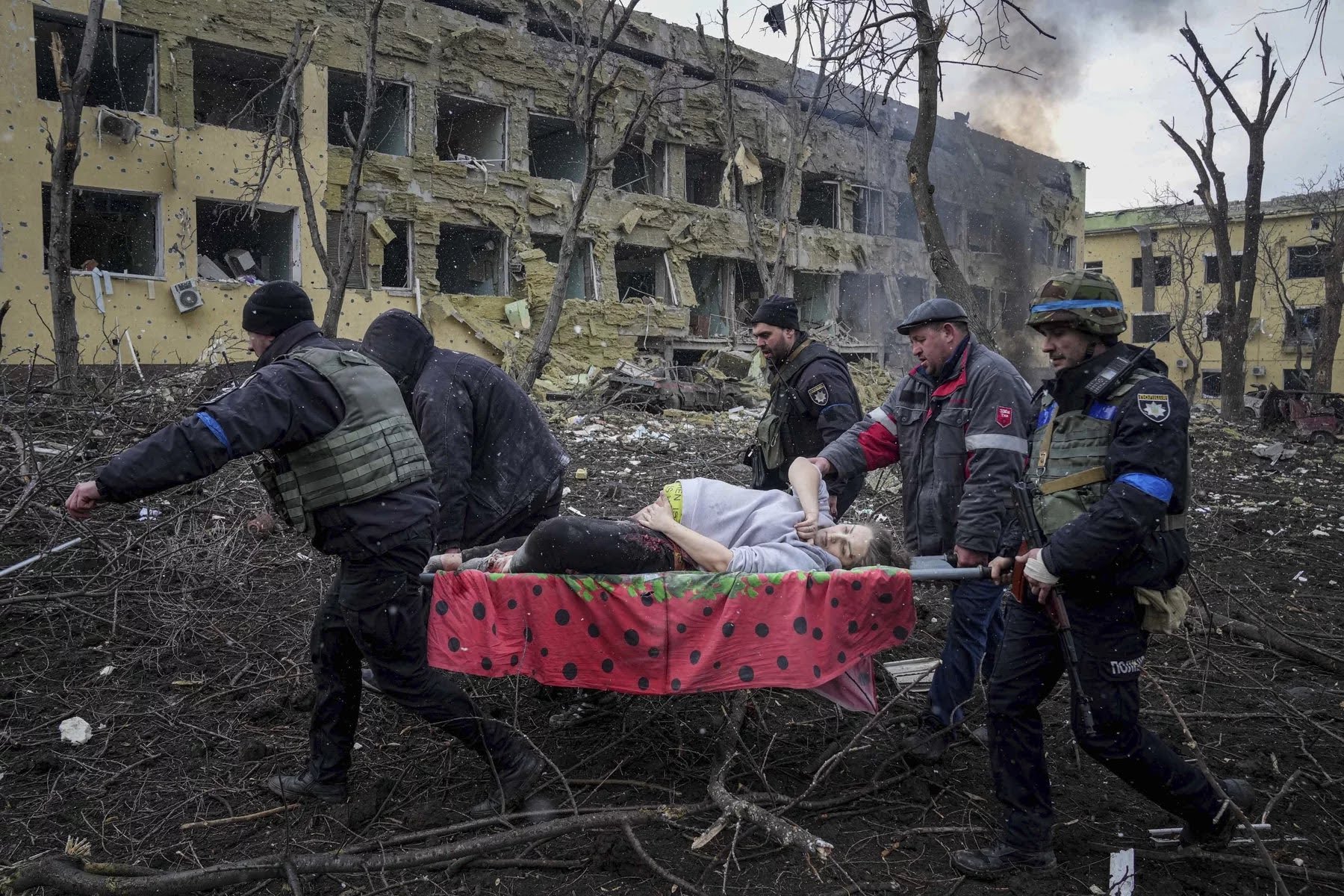
Starting in the morning and throughout the day, I watch the news about the war in Ukraine.  I see the people running from explosions.  I see hospitals and schools and hotels being blown up. I see masses of refugees in train stations struggling to find some way out of the hell that Ukraine has become.  I see mothers frightened, children weeping, fathers looking lost and hopeless.  I see them being killed too. 

War is hell and cruelty.

I watch this on the news and hear about it from my friends, and then I turn back to the things I usually do.  I have toast and cereal for breakfast, I step out into the garden and do some wedding, I go to the supermarket to buy some groceries that I’ll need for tomorrow and the day after. My life continues as it always does.  Putin’s war against Ukraine is just a momentary pause in my day.  Mostly I feel there’s nothing I can do about the terror and the destruction and the cruelty and the hell that the Russians have unleashed on the mother and fathers and children of Ukraine.

The war is constant for those people, and from what I know about how the invasion of Poland by Germany and the Russians affected my parents and the millions of Poles who survived that war, that suffering will never end.

War is hell for the victims of war.  For the rest of us who watch it on TV, it’s just a pause in our regular routines.  

We can talk about how terrible all this killing is.  We can send donations to Doctors Without Borders and the Red Cross.  We can write to our government representatives to do something to stop this war.  We can pray for all this killing to end.

But none of that is enough.  

Nothing is enough. 

War is hell and cruelty.


— my latest column for the Dziennik Zwiazkowy, the oldest Polish newspaper in America.


https://dziennikzwiazkowy.com/felietony2/wojna-to-pieklo-war-is-hell/

.

Monday, March 21, 2022

Pre-Post-Apocalyptic Blues

 Pre-Post-Apocalyptic Blues

Watching the news recently about Putin’s war against Ukraine,I can’t help feeling that we are all fascinated with the idea that the world may come to an end.  

This is nothing new, of course.  If you turn on your TV, you can binge any number of TV series about the end of the world.  It started with Walking Dead (2010) and continues through TV shows like The Last Ship, The Strain, Under the Dome, Extant, The Rain, Daybreak, Z Nation, Black Summer, Falling Skies, and so many, many more.  In fact, in preparing to write this column for the Polish Daily News, I googled “Best Apocalyptic TV series” and found a site that lists and describes the 100 best apocalyptic series.  I’m sure there’s another site that lists the 100 worst apocalyptic series.

And there doesn’t seem to be an end to these shows about the end of the world.  In fact, I’m really looking forward to HBO’s The Plot Against America, about American Alt-Right guys led by pro-Nazi Charles Lindbergh trying to take over the land of the free and the home of the brave in the early 1940s. 

Watching these series, you see the world brought to an end by zombies, vampires, meteors, alien invasions, and diseases like the coronavirus.

And God maybe.

I just started watching Leftovers -- the HBO series about what the world is like after what appears to be the Rapture happens and Jesus comes back to earth to take the really holy to heaven while leaving you and me behind.

It’s not pretty.  God doesn't take prisoners.

 Of course, all of this gets me wondering why this fascination with the end of things?  Is it because the world suddenly feels really old, and when you get to feel really old you start thinking about how things will end?

Or maybe it's because the world has ended -- virtually.  We spend so much time inside our homes watching the World Come to An End on TV that we don't realize that there's a real world still out there, the one outside my window, a world free of zombies and dogs and cars -- and people.

Hmmm.  It suddenly occurred to me that nobody has passed my house in the last 30 minutes or so.  No walkers or runners, no drivers driving cars or trucks.  Nobody.

Has the world ended while I was writing this column?

I better turn on the TV and see if there's anything left.

——-


A slightly different version of this article appeared originally in the Dziennik Zwiazkowy, the oldest Polish Daily in America, founded in 1908

Friday, March 4, 2022

War and Peace

War and Peace

We’ve all been following the Russian invasion of Ukraine. My 12 year-old granddaughter is following it, and my 97 year-old mother-in-law is following, and my best friend Bob who hasn’t followed the news since 1963 is following it. On the news this morning, I was told that even though only a third of Americans know where Ukraine is, 77% are anxiously following the war.

We all know the cause of the anxiety. We’re anxious that the Russian invasion will escalate into World War III.

This war started last week, and there doesn’t seem to be a quick stop to it coming up. I’m writing this column on Monday, February 28, and I just heard Belarus is preparing to send troops into Ukraine to support the Russians. Belarus also just issued a warning that all of this fighting may lead to World War III.

Hearing that, my anxiety grows as I’m sure yours does.

I was surprised, therefore, this morning when a friend sent me a copy of Polish Nobel Laureate Wislawa Szymborska’s poem “The End and the Beginning.” I love her writing, and I very much admire this poem, but I feel its optimism doesn’t fully express what happens when a war ends. When I first read her poem, I sat down and wrote “War and Peace.”

Here is her poem. My response follows. I’ll let you judge which poem gives a more accurate sense of what happens when wars end.

Wisława Szymborska

THE END AND THE BEGINNING

After every war

someone has to clean up.

Things won’t

straighten themselves up, after all.


Someone has to push the rubble

to the side of the road,

so the corpse-filled wagons

can pass.


Someone has to get mired

in scum and ashes,

sofa springs,

splintered glass,

and bloody rags.


Someone has to drag in a girder

to prop up a wall.

Someone has to glaze a window,

rehang a door.


Photogenic it’s not,

and takes years.

All the cameras have left

for another war.


We’ll need the bridges back,

and new railway stations.

Sleeves will go ragged

from rolling them up.

Someone, broom in hand,

still recalls the way it was.

Someone else listens

and nods with unsevered head.

But already there are those nearby

starting to mill about

who will find it dull.


From out of the bushes

sometimes someone still unearths

rusted-out arguments

and carries them to the garbage pile.


Those who knew

what was going on here

must make way for

those who know little.

And less than little.

And finally as little as nothing.


In the grass that has overgrown

causes and effects,

someone must be stretched out

blade of grass in his mouth

gazing at the clouds.


John Guzlowski

WAR AND PEACE


War will kill you

and leave you

cold in the street

or in the fields,

broken in the rubble

of bombed buildings


But don’t worry:

peace will come

and bury you

and sit over you

weeping like your mother,

praying for you,

pleading for your return


She’ll whisper to you

like when you were

a boy in the stream

washing your hands and face

before breakfast


She will weep until

God brings a miracle:

you risen again

in golden rays

and singing birds


and then war

will return

and kill you

——

My latest column for the Dziennik Zwiazkowy, the oldest Polish newspaper in America. 


https://dziennikzwiazkowy.com/felietony2/wojna-i-pokoj-war-and-peace/


.

Friday, February 18, 2022

Maus and Me


 Maus and Me

You’ve probably been hearing a lot about Art Spiegelman’s book Maus recently.  His graphic memoir about the Holocaust was banned in Tennessee, and as a result, many of my Polish and Polish American friends on social media have been talking about it.

I’ve been a fan of Spiegelman’s Maus for a long time.  I first read this memoir about his father and his experiences in the Holocaust in 1990.  

My  connection with the book was almost instantaneous. Spiegelman and I shared so much. We both loved comic books for one thing. My great dream growing up was to write and draw comic books.  The dream never came true for me, but it became true for Spiegelman.  His graphic novel (i.e.  comic book) was the only one to ever win a Pulitzer Prize.  Another thing that connected us was that we both had Polish parents who were victims of the Germans.  My Catholic parents were sent to concentration and slave labor camps in Germany.  His Jewish parents went to Auschwitz. They all survived the war.  Finally, Art Spiegelman and I both wrote about our parents and the horrors they went through.  He wrote Maus and I wrote Echoes of Tattered Tongues: Memory Unfolded. Like I said, I like Maus very much, and when I was still teaching I used to teach the book as often as I could.  

The Tennessee ban on Spiegelman’s book is pretty ridiculous.  The school board banned it – not for it’s portrayal of the Holocaust – but for its use of curse words and some nudity. 

What surprised me more was the reaction on social media.  Many Poles and Polish Americans attacked Maus for what they felt was its negative portrayal of Poles during World War II and the Holocaust. In the book people of different nationalities are seen as different animals.  Jews are mice, Poles are depicted as pigs, Germans as cats, etc.   That Poles are pigs is offensive to some readers, but the biggest complaint I hear is that the Poles are depicted as bad.

Are there negative portrayals of Poles in Spiegelman’s Maus?  Yes, there are.  For example, some Poles prisoners are seen assisting the Germans in Auschwitz, some Poles are seen betraying Jews, and some Poles are said to have killed Jews during the war.  

Is the portrayal of Poles entirely negative?  No.  Poles are also seen warning Jews that Germans are coming, Poles are seen being threatened by the Germans, Poles are seen treating Jews they know like family.  

What finally are we to make of this?

For me, it seems clear.  War and its chaos and infinite deaths creates a situation like nothing we have ever imagined.  Some of us – whether Polish or Jewish or German – turn against others, and some of us don’t.  

My mother spent 3 years in a slave labor camp.  She survived because one of the Germans guards at the camp took pity on her.  My mother used to say there were good Germans and bad Germans, and she forgave the good ones.  

For me, this is one of the lessons of Spiegelman’s Maus.  Forgive the good people.

——

My latest column for the Dziennik Zwiazkowy,  the oldest Polish newspaper in America.

Thursday, February 3, 2022

Our First Year in Chicago


 Our First Year in Chicago


After working for a year on a farm outside of Buffalo, New York, to pay off our passage to America from the refugee camps in Germany, my family came to Chicago.  We were told that there was plenty of work there and that the work was easy.  We were told the work in Chicago was nothing like it had been in the slave labor camps in Germany or the farm outside of Buffalo. So my mom and dad and my sister Danusha and I took the Greyhound bus to Chicago.


That first year in Chicago, we were always moving from one place to another, from one kind of poverty to another kind of poverty that was a little easier on us.  When we first came to Chicago we had little money, so we had to live in the cheapest place.  It was a shed behind a bar on North Avenue.  Then as my parents found work we moved to another place and another place and another place.


We lived on Milwaukee Avenue, Hamilton Avenue, Belden Ave, North Avenue, Campbell Avenue, and Shakespeare Avenue.  We lived in Bucktown and Wicker Park and Humboldt Park.  We lived in sheds and two-room apartments and four-room apartments.  At one point, we even lived with four other Polish refugee families in one apartment and shared a bedroom with one of the families.  


In our first Chicago home, we slept on bare floors, and then when my parents made some money, we slept on mattresses on those bare floors, and then when my parents made more money, we slept in a small bedroom on two small mattress that were both too small, but still we somehow managed to sleep on them.  


No place was really home for much of that first year.  It was just someplace to gather and wait and hope as we looked around Chicago and tried to find the next place.  


And as we looked around we saw other Polish refugees just like us.  That was one of things that my parents loved about Chicago, the sense that we were here with so many people that had gone through the same experiences as we had, people who had lost their country and their families and their lives in the war, people who had the same dreams of finding new lives my family had.


My family loved that, and my family also loved the sense that there were no limits here to what we could dream and do.  For years my dad worked two shifts a week and my mom worked a midnight shift so that they could buy the home they dreamt of.  


Both of them had been ripped out of their homes by the Germans during the war and put in concentration and slave labor camps, and after the war they lived in a Displaced Persons camp for six years. and in all of those years they never felt that they had a home that was their own.  But Chicago with its jobs and opportunities gave them that chance to own a home.


Three years after coming to Chicago, they bought a three-story building on Potomac Ave.  Looking back on it now, I shake my head as I think about what a dump it was.  It had three small apartments and no central heating and a basement with a dirt floor, but still it was a home to my family, and my mom and dad felt like they had achieved a life that they never dreamed of in the camps during the war.  Now, they were landlords!


This article first appeared in the Dziennik Zwiazkowy.

Saturday, January 22, 2022

Looking for Fun in the Pandemic

 LOOKING FOR FUN IN THE PANDEMIC 

One of the things I hate most about the pandemic (besides the fact that it’s killed millions around the world) is that it’s made it hard for us to have fun. 

Remember the old, pre-pandemic days?  

Remember when we used to go maskless to restaurants and never think about how close we were to the others seated in the restaurant, never worried about whether they were vaccinated? Remember when we would just walk smiling into our favorite Italian restaurant, and the waitress who we’ve known for years would greet us and show us to our favorite table, and she was maskless and smiling too, and we all existed in a world where everybody was smiling and welcoming and warm.

If you went back to that restaurant today, probably everybody would be masked and anxious, and you might have to wait for a while to be seated because the restaurant is so short staffed.  Or what’s worse, the restaurant might have closed down a couple weeks ago – like my favorite restaurant just did – because people had stopped coming and COVID has taken out the staff.

And do you remember going to movie theaters and bars and libraries and museums and bowling alleys and churches?  Do you remember visiting friends?  Getting a hug when you came to their door? Sitting down on a couch with them?  Sitting so close – with no sense of social distancing – that you could actually put your hand out and pat them on the back when they said something really funny?

It’s been two years now since we first heard about the strange virus that was causing Wuhan in China to go into lockdown.  And the news hasn’t gotten better. The Delta variant and the Omicron variant have seen to that.  As of this afternoon, there have been 66.5 million cases reported in the US, and 851,000 deaths.  That’s a million more cases and a thousand deaths since yesterday when I started thinking about writing this column about fun in the pandemic.

So faced with all this bad news, what can we do to have fun in this pandemic?

I’ll tell you what I’ve discovered.  I’ve discovered that watching TV isn’t fun.  Maybe it’s different for other people, but sitting there in front of the TV and waiting to laugh at some old movie or jump up with excitement when superheroes start flying around isn't fun for me.  I’m still thinking of COVID and all the things I’d rather be doing.

What does give me fun, however, is having my family around, talking about the vacations we took in the  old days, looking at photos from a dozen years ago, playing board games with our daughter and her daughter, baking things in the kitchen, watching our 12-year old granddaughter practice her ballet moves.  

Those are the things that let me forget for a little while the mess this pandemic has created.

My latest column for the Dziennik Zwiazkowy, the oldest Polish newspaper in America.

https://dziennikzwiazkowy.com/felietony2/w-poszukiwaniu-radosci-podczas-pandemii-looking-for-fun-in-the-pandemic/


.

Sunday, January 16, 2022

GODS

 Gods


  1.  My God is God


My God lives in heaven and He lives here

In my heart and the hearts of those around me.

His thoughts are pure and true and gentle, 

and his truest wish is to dream of babies 

playing in water soft as white roses.


When His lips come together in a smile 

The heavens smile too and the rains say

“Goodbye, goodbye, the sun is coming”

And when He smiles men are never hungry 

and their wives have eyes as soft as roses too.


And where my God is, there are no strangers,

only brothers who will take our hands

And kiss our cheeks for luck along the road,

No matter how hard it is, no matter how long.


  1.  Your God is the Devil  


He wears a broken hat and dead man’s clothes

and he comes from a place where men are hungry

and children die in the dirt waiting for dawn.


Nothing your stupid god wishes for comes true:

If he prays for peace he gets cyclones,

twisters that shred his skin like razors

and rain sorrow on all who pray to him.


If he wishes for love among brothers

he gets brothers who spit at each other,

fathers who beat their sons on their weddings days, 

daughters who flaunt their evil shoes and dresses

before their mothers and holy grandmothers.


Your god is a straw thing who fears my boot

And what I can do to him with my hands.