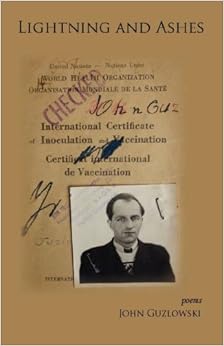
One of the most criticized essays I ever wrote for this blog was entitled
"All Holocausted Out: What I Think of Non-Jews Using the Word Holocaust." The essay
was about whether or not I could rightly describe my parents' experiences in the slave labor and concentrations camps of Nazi Germany as being a part of the Holocaust. A number of readers felt strongly that I had no right to appropriate that term to talk about what happened to my parents. These readers felt the Holocaust is a term that should only be applied to what happened to the Jews.
I wasn't surprised by the reaction to my essay. I've been following discussions by Jews and Poles about the Holocaust and World War II for years, and I knew that there were strong views on both sides about what happened during the war and about how those things that happened are perceived.
I was grateful when Piotr Florczyk sent me a link to his L. A. Review of Books review of Louise Steinman's memoir on Polish-Jewish relations because it helped clarify for me what the controversy was and offered a way, hopefully, out of it.
Here's his essay:

TO CALL THE
POLISH-JEWISH RELATIONSHIP complicated would be an understatement, and to label
it uneasy or acrimonious seems both inadequate and unfair. But we must use
words — aside from “long” — to describe the common history of the two
peoples, which goes back to at least the 12th century. There was a time when
Polish royals welcomed and encouraged Jews to settle in their land, which is
one reason why Poland had been home to the largest and most vital Jewish
community in all of Europe as recently as 100 years ago. What remains of that
rich culture is of course paltry; the Nazis destroyed an 800-year-old community
in six years. World War II spelled the end for 90 percent of Poland’s prewar
Jewish community, among them some of humanity’s best and most promising
scientists, academics, politicians, musicians, artists, and writers. While many
acknowledge the profound crisis that has hung like a black cloud over Polish-Jewish
relations since that time, few have provided any insight into how best to break
the impasse.
It is the shape of Polish-Jewish relations in the present
that concerns Louise Steinman. In the search for the remnants of her own
family, she cannot help but trace and address the many unresolved issues that
still stand in the way of a sustained dialogue between Poles and Jews, a
dialogue that would at last put them on the path toward true reconciliation.
Steinman’s book,The Crooked Mirror, will no doubt be part of that
reconciliation.
Some people are
forced to bear witness; others volunteer, as in the case of the journalist or
relief worker. And others, like Steinman, are called back to witness something
that can only be glimpsed by solemn digging. These kinds of witnesses offer
their labor, their connection to others on a similar quest, and their profound
feeling to the dead; what else can we do now that so few of the living
witnesses remain?
“The Jews may have once been part of Poland’s body and soul,
but they’d been excised, cast out,” writes Steinman. As a granddaughter of
Polish-born parents, Steinman grew up feeling an animosity toward all things
Polish deep within her family. Her mother could barely utter the name of the
country. Rebecca, Steinman’s grandmother on her father’s side, told stories in
heavily accented English about being smuggled into Poland
from Ukraine in 1921 during that country’s civil war. But from the maternal
side, radio silence. “Even as a child and without knowing why,” writes Steinman,
“the absence of family history on my maternal side was a gap, an ache.” And so
while she continued to live her life in Los Angeles, Steinman took up a second
life as a historian on a series of journeys into Poland, a historian whose
guiding questions were intensely personal and sometimes unclear even to her.
In her
introductory chapter Steinman reminds us that “an estimated 80 percent of
American Jews are of Polish-Jewish descent,” and she goes on to point out that
most of them exude more animosity toward Poland than toward Germany, believing,
erroneously, that the Nazis had set up their death camps in Poland because they
could count on the locals to help them exterminate the Jews. Those Polish-Jews
who survived the Holocaust only to be chased out of the country by their former
neighbors wanted nothing to do with Poland; their experiences and the stories
they told contributed to the image of Poles as most vile anti-Semites. Only the
most intrepid, in both communities, have tried to find what unites rather than
divides them.
It is Steinman’s
Zen rabbi in Los Angeles who encourages her to get involved in establishing a
dialogue between Poles and Jews. At first, she does not see this as her
calling, but in the course of nine trips over a decade, she discovers a
deep-seated affinity for Poles and the country as a whole. Much of this
awakening stems from her working with Polish guides and translators in their
20s and 30s. These are the new ambassadors to Poland, so much more open and
tolerant than their parents and grandparents. On her first visit, Steinman
attends a Bearing Witness Retreat, held in the former Nazi death camp
Auschwitz-Birkenau, where she participates in workshops with others from
Poland, Germany, Switzerland, Great Britain, Italy, the Netherlands, France and
Israel, most of them the children and grandchildren of survivors. One night
they listened to the stories of a Polish actor who had worked as a slave
laborer at the camp when he was 19. When the man characterized the Jews in the
camp as more passive than the non-Jewish Poles, he angered many of the
visitors. Immediately the group was plunged into the quandary of the book ––
how to find a way to talk about the thorniest of subjects.
The language
Steinman employs in this lyrical yet magisterial book testifies to the depths
to which she’s gone, as both a researcher and someone marked by the Holocaust,
to ask for and offer forgiveness and understanding. Recounting multiple trips
to Radomsko, a provincial town in south-central Poland, in search of her
family’s roots, she elucidates the more important points of general Polish
history, including the three partitions at the end of the eighteenth century,
after which the country disappeared from the map for 123 years, as well as the
fact that “of all the countries in Nazi-occupied Eastern Europe, Poland was
subjected to the most severe and sadistic repression.” Indeed for any Pole
during World War II saving the life of a Jew meant risking the lives of
everyone in his or her family. Yet among the nationalities bestowed with the
title of “the Righteous Among the Nations” by Yad Vashem, the Israeli Center
for Holocaust Research, Poles constitute the largest group. Some have tried to
downplay the fact, pointing out the relatively small number of honored Poles,
given the country’s total population and the size of its Jewish minority before
the war, but Steinman refuses to play the statistics game, turning instead to a
metaphor and asking “why does one person reject the view through the crooked
mirror and another accept the distortion?” The answer lies at our fingertips,
Steinman seems to suggest, yet remains stubbornly out of reach.
The convoluted, not to
mention bloody, history of much of Central and Eastern Europe, including its
peoples’ narratives of victimhood and resistance, is the key to understanding
the deep-seated prejudices that divide the two communities. As part of her
strategy to learn more about it, Steinman attended a kind of working retreat at
Wannsee, outside of Berlin, where in early 1942 the Nazis had met to outline
their plans for the Final Solution. The goal of the more recent gathering,
organized by One by One, an organization founded in the 1990s by descendants of
“survivors, perpetrators, bystanders, and resisters,” is to explore the legacy
of the Holocaust and Hitler’s regime. The “conspiracy of silence” that
prevailed in both West and East Germany after the war had also been in force in
Poland, Steinman learns. This isn’t to suggest that Poles did not wage a heroic
battle against both German and Soviet occupiers, which they did, and she says
so; rather, what was absent from the postwar narrative is what had happened to
the country’s Jewish citizens during and after the war. It was primarily the
Nazis who had slaughtered them, of course, but there were also thousands of
incidents in which local Poles, mainly peasants living in the countryside,
killed Jews or otherwise contributed to the already miserable prospects they
faced by either leading the Germans to their hideouts or barring them from
returning to their homes after the war. While some of the perpetrators were
tried and sentenced after the war, these shameful facts had been downplayed,
and thus never entered the country’s postwar narrative, most of which continues
to center around the Poles’ valiant struggle against their occupiers.
All this began to change after Jan Gross’s Neighbors was
published in 2000. The book, written by a Polish-American historian, documents
the killing of 600 Jews in the village of Jedwabne, on July 10, 1941; the
victims were herded into a barn that was then set on fire. Gross made public
that “the atrocity was perpetrated by the Jews’ Polish neighbors, not German
soldiers, as had been previously assumed.” The ensuing dialogue in Poland has
been compared to a “huge national psychotherapy session.” Writing in his 2007
bestseller Fear: Anti-Semitism in Poland After Auschwitz, from
which Steinman quotes, Gross offers a two-pronged explanation for why Poles
turned on their neighbors: the Poles were betrayed by the Soviets — who
arrested and deported thousands of Poles during the war, and in the aftermath
of the war executed Poland’s Home Army heroes. The Jews returning from the
camps were betrayed by Polish neighbors who appropriated their homes, property,
and jobs. “A combination of greed and guilt made the sight of the returning
Jews so threatening to their Polish neighbors,” writes Gross. At the ceremony
marking the 60th anniversary of the Jedwabne massacre, in July 2001, the then
Polish President Aleksander Kwaśniewski apologized “in the name of those Poles
whose conscience is moved by that crime.”
Steinman compares
the Poles’ response to Jedwabne to the massacre at My Lai, and our own
country’s search for truth, while addressing the issue of collective punishment
experienced by civilian populations of all armed conflicts as well as the
selective amnesia that follows. In order to break taboos and open a dialogue,
Steinman reaches out to the Poles she meets, and in no time discovers how much
it pains some of them, including her guide and translator, that Jewish visitors
to Poland focus only on the Holocaust rather than the centuries-long history of
the Jews in the country. She responds — perhaps unaware that she’s echoing the
Poles’ own oft-repeated summary of what had happened to them during World War
II — that “those five years were not like any other five years,” to which her
guide replies, “without those 800 years of Jewish life in Poland, you cannot
understand what was lost in those five.”
Soon Steinman and
another American Jew — who is herself struggling to come to terms with her own
horrific family history and who becomes Steinman’s companion for many of the
trips in and around Poland — meet with four university students. The issues
that arise between them have been standard fare as points of contention. For
instance, the young Poles rightly claim that there’s no shortage of events and
organizations celebrating Jewish culture in Poland, citing as an example the
hugely popular annual Jewish Culture Festival in Kraków, ”which is often
criticized by Jews because it’s mostly attended by non-Jewish Poles.” One of
the students contends that the main obstacle on the road to reconciliation is
the fact that Jews perceive all Poles in an overwhelmingly negative light. Quoting
the writer Eva Hoffman, whose own family left Poland after the government-led
1968 anti-Semitic purges, Steinman suggests that “the varied tonalities of
feeling and opinion that must have existed in the long centuries of
Polish-Jewish coexistence have been lost in the absence of actual contact.”
Ironically, there
is perhaps no greater issue at present dividing the two communities than the
March of the Living. Organized by Israeli government, these trips to Poland,
during which young Jews visit the former concentration camps and ghettos, had
until recently been off-limits to Poles, including Polish Jews living in
Poland. What’s more, according to one Polish Jew living in Warsaw whom Steinman
quotes, not only were the Israelis discouraged from meeting the locals, they
came equipped with orientation fliers that stated something to the effect of
“You shall see the local inhabitants. You shall hate them for their part in the
atrocity. But you will pity them for their miserable living conditions.” While
the fliers have been rewritten and the hateful language removed, the
misunderstanding persists. The young Israelis see Poles as the embodiment of
anti-Semitism, while Poles see the Israelis as ignorant of Poland’s culture and
history in general.
A trip to Kolomyja,
in today’s Ukraine, does not bring closure or relief for Steinman’s friend
whose father was born in the town — in fact, it further magnifies the woman’s
pain and desolation. Steinman’s repeated trips to Radomsko, her family’s
long-ago home, turn out more fruitful. She meets many Poles, whom she calls
“memory workers,” people involved in cultivating the memory of Jews — “not
because they’re philo-Semitic but because they’re philo-Polish.” Touring the
Radomsko Region Historical Museum, Steinman is initially dismayed that the
exhibit commemorating the region’s Jews amounts to “just one glass case,” but
then she’s reminded that before the case there was nothing, that the handful of
artifacts is a sign that things have changed. Seeing school kids act in a Purim
play, she comes to believe that the children perform as a way to “salvage an
essential part of their own history.” Quoting the Egyptian writer Edmond Jabès,
who, writing about Jewish heritage, eschewed continuity in favor of the phrase
“permanent rupture,” Steinman writes, “I was the rupture. I was the
continuity.” Indeed, she is both, and the same can be said about like-minded
Poles; they “will never hear ‘thank you’ from the dead” for their work, but
they need to hear it from us.
Coming to Poland against the wishes of their relatives,
people like Steinman should be applauded for their willingness to face their
own “unexamined prejudices.” Meeting the Other, understanding what has shaped
his or her views, isn’t easy. Not all such journeys and encounters have
positive outcomes, but many do. In Radomsko Steinman cuts the ceremonial ribbon
at the opening of a new Radomsko Cultural Center, thus getting acknowledged as
one of their own, a Radomsker. In L’viv, following a heartbreaking trip to
Kolomyja, a Ukrainian woman embraces Steinman’s friend and whispers, “Welcome
home.” At the Galicia Jewish Museum in Kraków, a photograph taken in a small
village — in which a grove of trees in the middle of a plowed field marks the
site of the Jewish cemetery — leads Steinman to conclude that “the presence of
the past is kept alive by the observance of absence.” Some Poles may not be
comfortable talking openly about what had happened to their Jewish neighbors,
but they do remember it, and more and more are willing now to face what
happened if only among themselves.
Appropriately,
the variegated story told by Steinman has two endings. One leads the author
back to her native Los Angeles, where she meets a distant relative who
remembers the pre-war Radomsko. This woman “embodied all the dizzying
polarities and contradictions of the historical debate between Jews and Poles.
She’d been rescued by brave Christian Poles who risked their lives — and the
lives of their families — to hide her. At war’s end, she’d been chased out of her
home at gunpoint by venal profiteers.” The second ending leads Steinman back to
Radomsko, where, in 2008, she takes part in dedicating a monument at the site
of the Great Synagogue, commemorating the town’s Jewish community and the
liquidation of its ghetto. It is this collective memory, as Steinman writes,
quoting the Radomsk Yizkor, that links us to “the time when a Polish Catholic
painted the zodiac on the ceiling of Radomsko’s Great Synagogue and a Polish
Jewish tinsmith designed the spires of the town’s cathedral.” We are left to
ponder the image of an elderly man, a Pole who rescued a Jew and has only
recently been honored by Yad Vashem, standing side-by-side on a train platform
with that Jew’s son. Steinman writes, “they had only met for the first time the
day before, and yet they already knew each other so well.” One might add that
while they share the past, it’s really looking forward to the future that
unites them.
This overdue book couldn’t have been easy to write.
Heartfelt, poignant, redemptive, and brave, it offers proof that Poles and Jews
can lead a constructive dialogue. Poland is not free of anti-Semitism —
perpetrated by people from all walks of life, but mainly those who missed out
on political and economic opportunities brought about by the country’s
transition to democracy and accession to the European Union, many of whom
subscribe to the thinly-veiled xenophobic messages of Radio Maryja, a religious and socially conservative
broadcasting service led by Father Tadeusz Rydzyk. For their part, many Jews
continue to cling to various stereotypes of Poles, even though they have never
actually met a Pole. Poland’s burgeoning Jewish community itself contradicts
the message that in Poland “you come to visit death … then you travel back to
Israel to see resurrection.” With remarkable generosity and an unwavering sense
of purpose Louise Steinman writes about the people she meets and the places she
visits in Warsaw, Kraków, Radomsko, Vilnius, Lublin, Sejny, Paris, Kolomyja,
and L’viv, finding that things are in fact changing for the better. For those
still unconvinced, this book is the proof and the way forward.
¤
Louise Steinman's The Crooked Mirror is available from Amazon.